Summary
The perfect free learning site for you is Learn Claude Code (learn.shareai.run).
Learn Claude Code Complete Guide 2026: The Free Learning Site That Builds Your Own AI Agent from Scratch in 20 Sessions
"Claude Code-like AI coding agents — how are they actually built?"
"I want to learn agent internals at the code level..."
The perfect free learning site for you is Learn Claude Code (learn.shareai.run).
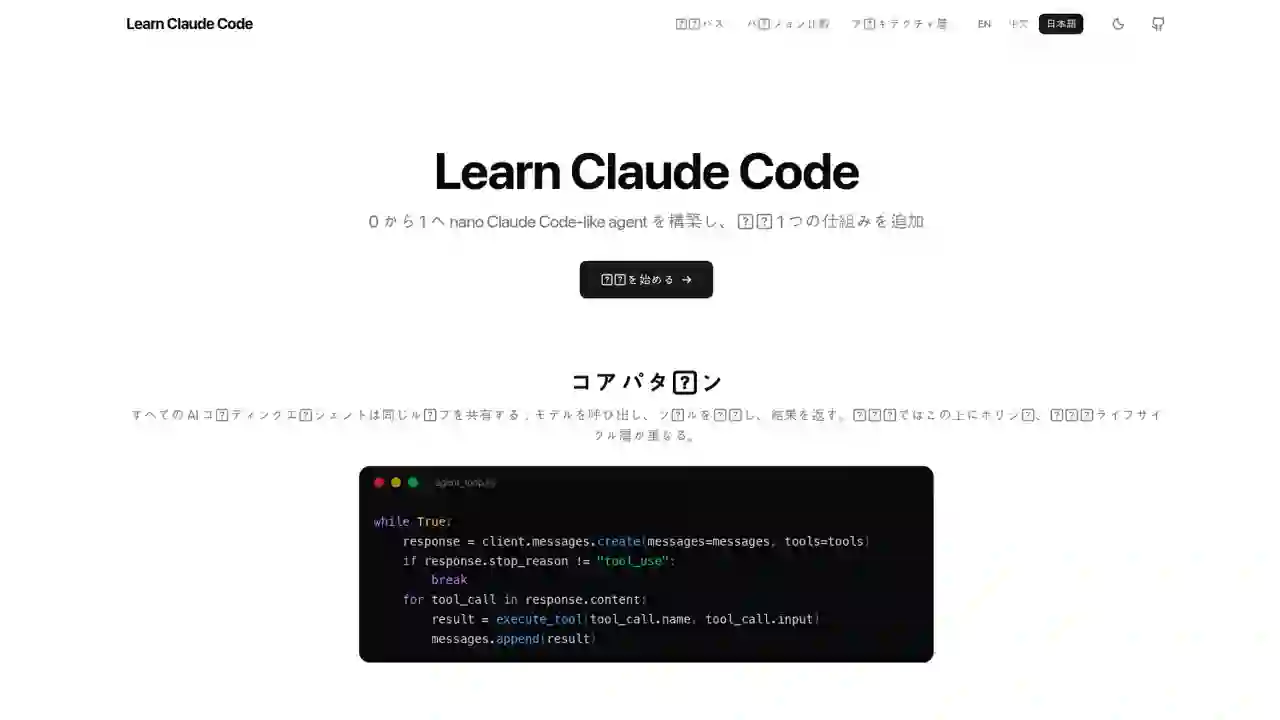
This site takes you from 0 to 1, building a nano Claude Code-like agent while adding one mechanism at a time. From a simple agent loop to a full multi-agent harness, you learn across20 progressive sessions.
All the code is readable right in the browser, and each session comes with a real implementation of 102–1,708 lines. It supports Japanese, English, and Chinese.
In this article, I'll break down the whole picture of Learn Claude Code — the learning path, every session, and how to get started.
What You'll Learn in This Article
- What Learn Claude Code is (and what you can learn)
- The core pattern: the agent loop
- The 20-session learning path and what each covers
- The 5 architecture layers
- How to study effectively
What Is Learn Claude Code?
Learn Claude Code is a free learning site for building a Claude Code-like AI agent from scratch.
Key features
- 20 progressive sessions: learn in order, from a simple loop to a complete multi-agent harness
- Real code included: each session ships with a Python implementation of 102–1,708 lines
- 1 session = 1 mechanism: add one feature at a time (tool execution, permissions, memory, etc.)
- 3 languages: Japanese, English, Chinese
- Free: no signup needed — read it straight from your browser
Site URL: https://learn.shareai.run/
The Core Pattern: The Loop Every AI Agent Shares
The first thing Learn Claude Code teaches is the basic loop shared by all AI coding agents.
Call the model, run tools, return results. In production, policy, permission, and lifecycle layers sit on top of this.
while True:
    response = client.messages.create(messages=messages, tools=tools)
    if response.stop_reason != "tool_use":
        break
    for tool_call in response.content:
        result = execute_tool(tool_call.name, tool_call.input)
        messages.append(result)
This simple loop is the foundation of every agent. The site's approach is to add one mechanism at a time on top of it — permissions, hooks, memory, subagents, and more.
The Learning Path: All 20 Sessions
Learn Claude Code consists of 20 sessions, s01 through s20.
| Session | Topic | What it covers |
|---|---|---|
| s01 | The Agent Loop | The smallest agent: a loop that calls the model, runs tools, and feeds results back |
| s02 | Tool Use | The loop stays stable while capabilities register into a dispatch table |
| s03 | Permission | Dangerous actions need a harness decision point before the shell runs |
| s04 | Hooks | Cross-cutting behavior belongs around the loop, not tangled inside it |
| s05 | TodoWrite | Explicit plans keep long-running work visible and correctable |
| s06 | Subagent | Subagents give each subtask a clean message history while preserving the main thread |
| s07 | Skill Loading | Inject specialized knowledge only when the task actually needs it |
| s08 | Context Compact | Compression keeps the conversation usable when the context window gets crowded |
| s09 | Memory | Some facts should survive summarization and future sessions |
| s10 | System Prompt | The system prompt is a generated product of policy, tools, skills, and context |
| s11 | Error Recovery | A robust harness classifies failures and decides what kind of retry is worthwhile |
| s12 | Task System | A task graph turns vague goals into ordered, observable work |
| s13 | Background Tasks | The agent can keep reasoning while slow work completes elsewhere |
| s14 | Cron Scheduler | Recurring work should be created by the harness, not remembered by the model |
| s15 | Agent Teams | Persistent teammates let work continue in parallel without stuffing every thought into one context |
| s16 | Team Protocols | Multi-agent systems need explicit message contracts, not vibes |
| s17 | Autonomous Agents | Teammates become useful when they can discover and claim work themselves |
| s18 | Worktree Isolation | Parallel agents need isolated filesystems as much as isolated conversations |
| s19 | MCP Tools | External services can become agent tools through a standard discovery and call protocol |
| s20 | Comprehensive Agent | The final harness is still one loop, now surrounded by the systems that make it production-shaped |
The 5 Architecture Layers
The 20 sessions are grouped into 5 orthogonal concerns (architecture layers).
| Layer | Sessions | Covered sessions |
|---|---|---|
| Tools & Execution | s01: The Agent Loop / s02: Tool Use / s03: Permission / s04: Hooks | |
| Planning & Control | s05: TodoWrite / s06: Subagent / s07: Skill Loading / s10: System Prompt / s11: Error Recovery | |
| Memory Management | s08: Context Compact / s09: Memory | |
| Concurrency & Scheduling | s13: Background Tasks / s14: Cron Scheduler | |
| Multi-Agent Platform | s12: Task System / s15: Agent Teams / s16: Team Protocols / s17: Autonomous Agents / s18: Worktree Isolation / s19: MCP Tools / s20: Comprehensive Agent |
This grouping lets you understand the whole agent from five perspectives: tool execution, planning, memory, concurrency, and multi-agent.
How to Study
1. Get the big picture on the homepage
Open the homepage first and review the core pattern and the overall learning path.
2. Work through s01 in order
Click "Start learning" and go through s01: The Agent Loop first — following the order is the recommended approach.
- Each session adds exactly one mechanism on top of the previous one
- The code grows gradually from 102 lines to 1,708 lines
- Reading the code carefully as you go deepens understanding
3. Or dive into just the layer you care about
If you already have some knowledge, reading only the sessions you need by architecture layer is also effective.
- Interested in multi-agent → s12, s15–s20
- Want to learn memory → s08, s09
- Starting from the basics → s01–s04
Summary
Learn Claude Code is a free learning site where you build an AI coding agent from zero, at the code level.
- 20 progressive sessions: from a simple loop to a complete multi-agent harness
- 1 session = 1 topic: build understanding by adding one mechanism at a time
- Real code included: Python implementations of 102–1,708 lines per session
- 5 architecture layers: Tools / Planning / Memory / Concurrency / Multi-Agent
- 3 languages, completely free: https://learn.shareai.run/
For anyone who wants to "understand how AI agents actually work, in code," this is the ideal learning material. Start your first step toward building your own agent with the agent loop in s01.
Related reading
- Claude Code Cross-Session Messaging Complete Guide 2026: Sessions Can Now Send Messages to Each Other
- Learn Harness Engineering Complete Guide 2026: The Free Course That Makes AI Agents Reliable with a "Harness"
- AI Coding Agent Complete Comparison 2026: Cursor vs Claude Code vs Codex vs Hermes vs Fugu
Share this article
Related articles
Aug 8, 2026
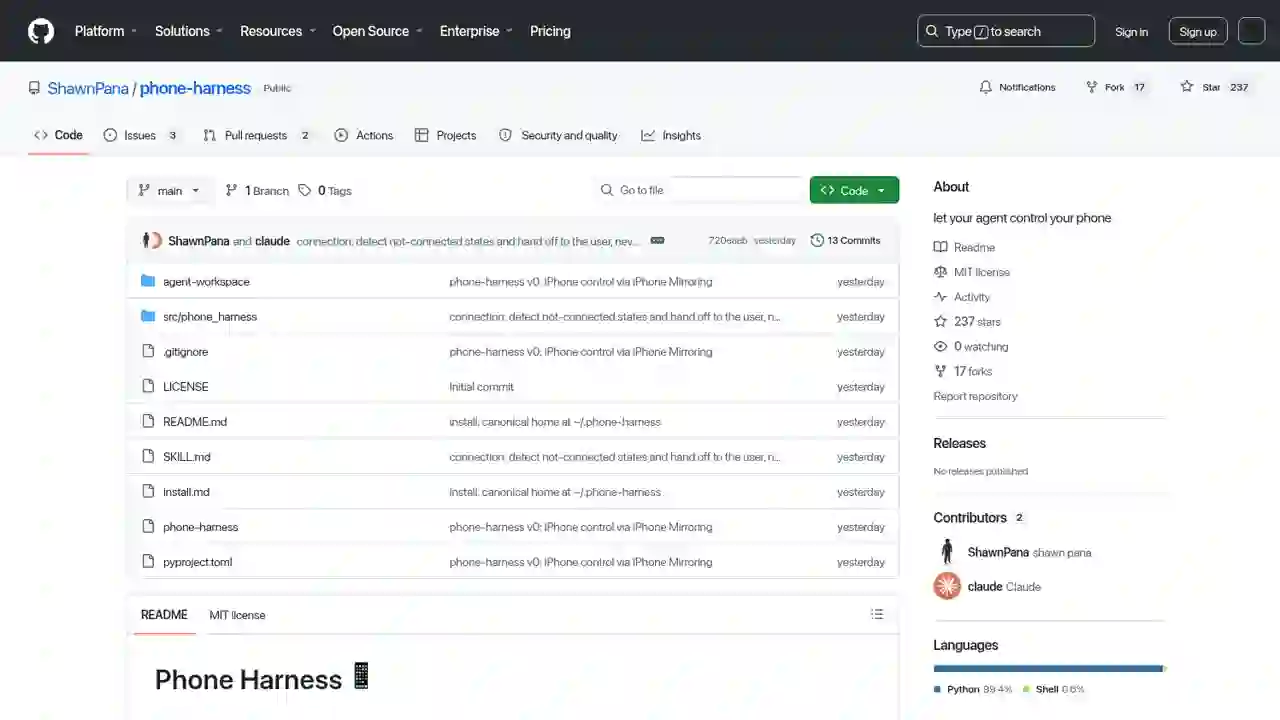
Control Your iPhone with Claude Code in 2026: Complete phone-harness Guide (with Setup Steps)

Aug 9, 2026
Hermes HUD Mode Complete Guide 2026: The Overlay AI Agent That Sees, Understands, and Controls Your Screen

Jun 22, 2026
Hermes Agent Complete Guide 2026: The Most Powerful Open-Source AI Agent by Nous Research
Aug 9, 2026
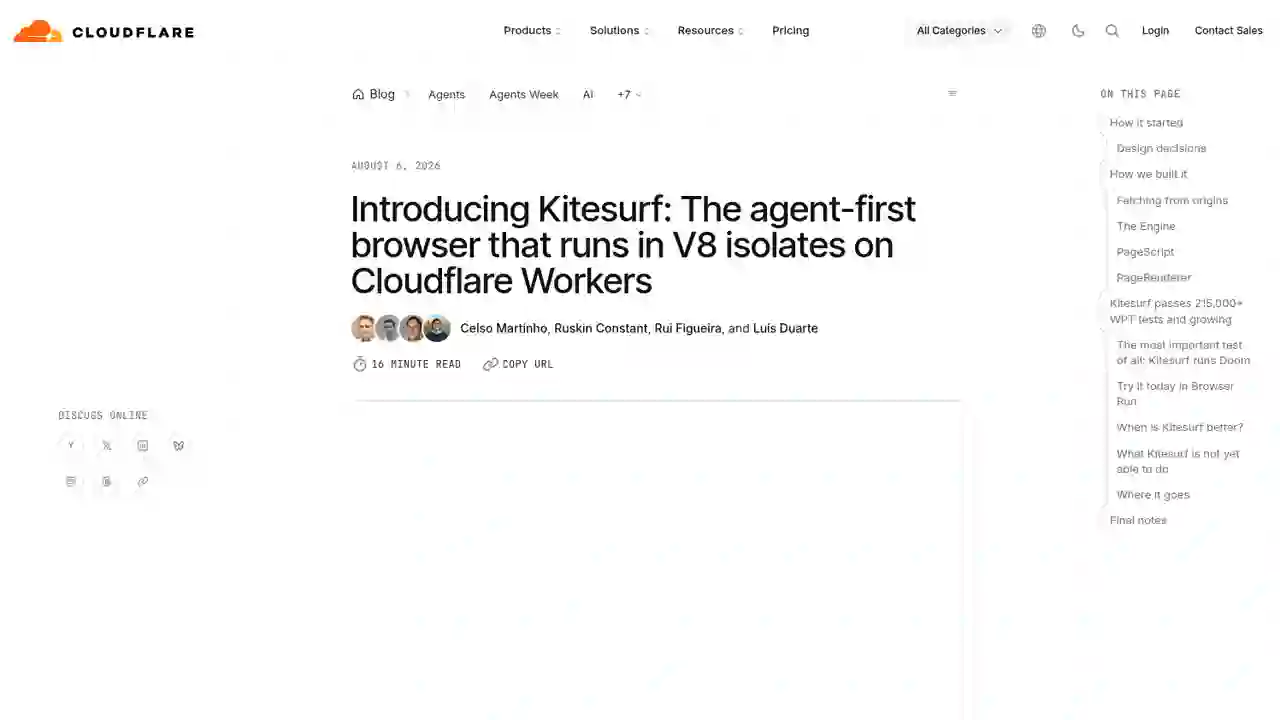
Cloudflare Kitesurf Complete Guide 2026: The Agent-First Browser That Uses Up to 7x Less Memory Than Chromium
Aug 14, 2026
Hermes Agent Bot Mode Complete Guide 2026: Turn Your AI Agents into a Team of Named Bots with Roles, Models, Memory, and Avatars
Aug 26, 2026
DeepSeek Harness Explained 2026: What It Can Do, How It Differs from Codex & Claude Code, and the Best Way to Use It