Summary
"Which AI coding agent should I use?"
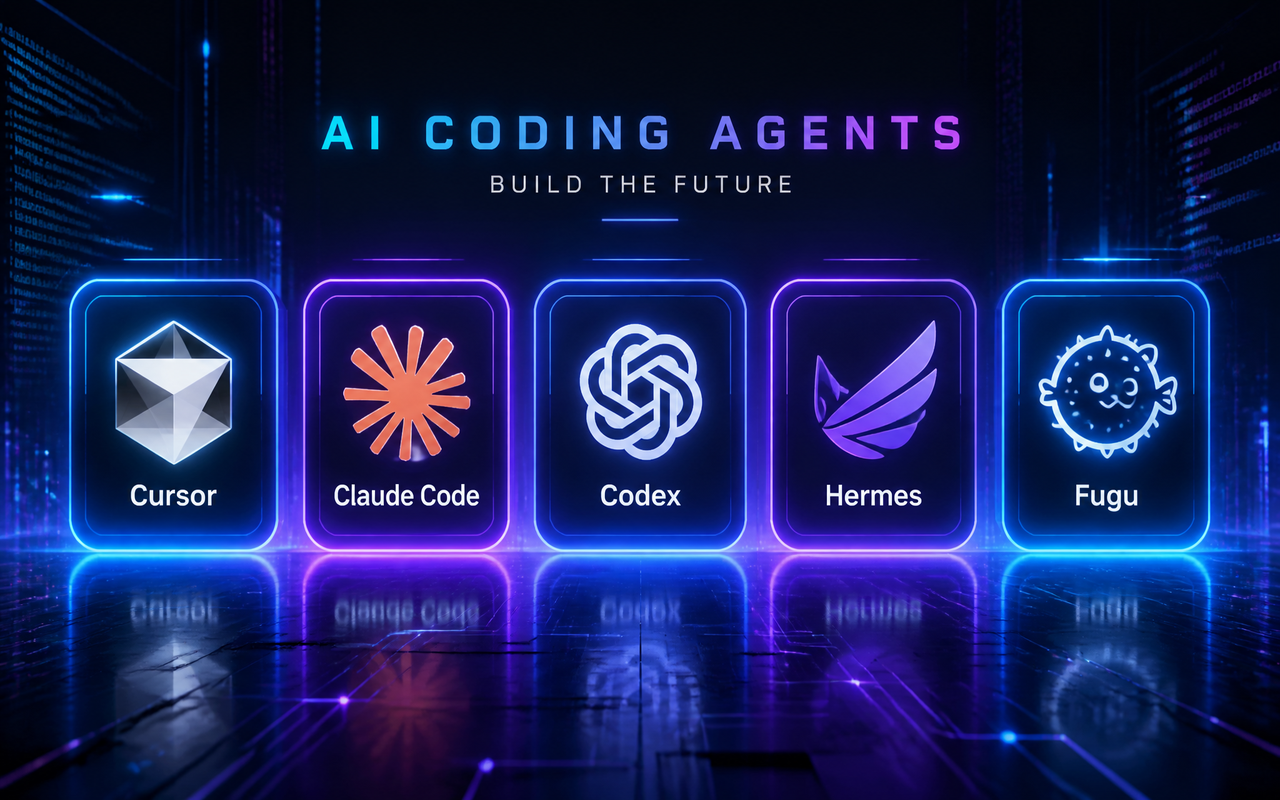
AI Coding Agent Complete Comparison 2026: Cursor vs Claude Code vs Codex vs Hermes vs Fugu
"Which AI coding agent should I use?"
In 2026, there are so many options it's overwhelming. Cursor, Claude Code, Codex, Hermes Agent, Sakana Fugu… they all claim to be "the best," but how are they actually different?
The bottom line: the ultimate approach right now is to use 2–3 agents together.
This article provides a thorough comparison of the top 5 AI coding agents as of June 2026, explained clearly for beginners too.
Quick Verdict: Recommendations by Type
| Your Type | Recommendation | Reason |
|---|---|---|
| For daily coding | Cursor | Best UX, context management, and unmatched for frontend development |
| For long-running autonomous tasks | Claude Code | Plan → execute → verify loop is the strongest |
| For tight GitHub integration | Codex | GitHub integration + visual verification loop, rapidly growing |
| For open-source and full control | Hermes Agent | Fully OSS, economic activity capable, rich plugin ecosystem |
| For the best benchmarks | Sakana Fugu | Dynamic multi-agent routing. SWE-bench Pro 73.7% |
What Is an AI Coding Agent?
It's a tool that doesn't just "write code when instructed" — you tell it your goal, and it autonomously works through to completion.
Traditional programming:
Human-designed plan → Human writes code → Human tests it
AI coding agent:
Human states goal → AI loops through planning, execution, verification, and fixes → Delivers finished product
The key point: humans can step into a supervisory role. You don't need to give detailed instructions — the AI thinks and acts on its own.
Top 5 Agents Comparison Table
| Item | Cursor | Claude Code | Codex | Hermes Agent | Sakana Fugu |
|---|---|---|---|---|---|
| Type | AI-native IDE | Terminal-first | Cloud agent | OSS autonomous agent | Multi-agent API |
| Developer | Anysphere | Anthropic | OpenAI | Nous Research | Sakana AI |
| Pricing | $20+/month | Usage-based | Usage-based | Free (OSS) | $20–200/month |
| Autonomy | Medium | High | High | Very High | Very High |
| IDE Quality | ★★★★★ | ★★★ (Terminal) | ★★★★ (Web/Cloud) | ★★★ (Terminal) | N/A (API) |
| Open Source | No | No | No | Yes ✅ | No |
| DeepSWE Score | 61 | 77 (Opus 4.8) | 76 (GPT-5.5) | Undisclosed | 73.7 (SWE-bench Pro) |
| Key Feature | Best flow state | Plan + verify loop | GitHub integration + visual verify | Economic activity + extensibility | Dynamic model routing |
Detailed Breakdown of Each Agent
1. Cursor — The Daily Driver King
In a nutshell: "The de facto standard for AI coding"
Cursor is an AI-native IDE forked from VS Code. It offers the most polished user experience, and many developers use it as their "daily editor."
Strengths:
- The Composer feature is incredibly smooth. Edit code while having a conversation
- Understands your entire workspace context. Large-scale refactoring is seamless
- Excels at frontend development. See visual changes in real time
- Dramatic speed boost while keeping the "hands-on coding" feel
Weaknesses:
- Struggles with fully autonomous long-running tasks (requires human approval)
- Closed source. Limited customization
- $20+/month subscription
Best for: "Every developer who writes code daily"
2. Claude Code — The Autonomous Execution Champion
In a nutshell: "The smartest agent. Plans, executes, and verifies."
Claude Code is a terminal-first AI agent built by Anthropic. Its greatest strength is the ability to autonomously run the "plan → execute → verify → fix → complete" loop.
Strengths:
- Autonomously completes complex multi-step tasks. You just supervise
- Supports MCP (Model Context Protocol) for external tool integration
- Holds the top DeepSWE benchmark score (77)
- "Hand it to Claude Code, and it's done by the time you wake up"
Weaknesses:
- Terminal-based. No visual editing like an IDE
- Usage-based pricing — costs add up on long tasks
- Lacks the "hands-on coding" feel of Cursor (feels like a black box)
Best for: "Those who want to delegate complex tasks to AI" / "Want it done while they sleep"
3. Codex — Rapidly Rising, Unmatched GitHub Integration
In a nutshell: "The most seamless GitHub integration"
Codex is a cloud-based AI coding agent developed by OpenAI. It has been growing rapidly since early 2026, especially making major strides in frontend quality.
Strengths:
- Overwhelming GitHub integration. Automates PR creation, review, and merging
- Visual verification loop is revolutionary. Write code → render → screenshot check → fix, all automated
- Excels at async work. Have it write code while you sleep
- Powered by GPT-5.5, scoring 76 on DeepSWE
Weaknesses:
- Cloud-based. Weaker with large local codebases
- UX hasn't reached Cursor-level polish yet
- Costs can climb depending on usage
Best for: "Those developing around GitHub" / "Those who want async work"
4. Hermes Agent — Fully OSS, Infinitely Extensible
In a nutshell: "For those who want full control"
Hermes Agent is a fully open-source AI agent framework developed by Nous Research. It's gaining attention as an "economically capable agent."
Strengths:
- Fully open-source. You can see everything under the hood. Customize freely
- Plugin system for extending functionality. Build your own agent
- Native economic features — the agent can directly purchase items and make payments
- Supports multiple LLM providers. Choose whichever model you like
Weaknesses:
- Hardest to set up. High barrier for beginners
- Documentation is still a work in progress
- Benchmark scores undisclosed. Harder to compare with other agents
Best for: "OSS enthusiasts" / "Those who want full control" / "Technically advanced users"
5. Sakana Fugu — The Newcomer, Benchmark King
In a nutshell: "The dark horse of June 2026"
Sakana Fugu is a multi-agent API developed by Japan's Sakana AI. A single API call dynamically routes tasks internally across multiple specialized agents.
Strengths:
- Multiple AIs collaborate internally to process tasks. Automatically routes to the best agent
- Stunning benchmark scores (SWE-bench Pro 73.7%, LiveCodeBench 93.2%)
- OpenAI-compatible API. Easily callable from existing tools
- Relatively affordable at $20–200/month
Weaknesses:
- Brand new, released June 2026. Limited track record
- Not available in the EU
- API only. IDE and editor integrations still developing
Best for: "Those wanting to try the benchmark king" / "API users" / "Those who want to support Japanese AI"
Recommendations by Use Case
| Situation | Best Combination | Reason |
|---|---|---|
| Web app development (front + back) | Cursor as main + Claude Code for auto-testing | Blazing fast coding with Cursor, automated testing with Claude Code |
| Large-scale refactoring | Claude Code alone | Plan → execute → verify loop is the most reliable |
| GitHub-based team development | Codex alone | GitHub integration is king. Automates PRs and reviews |
| Research / experimental dev | Hermes Agent | OSS, freely customizable. Try new models instantly |
| Embedding via API | Sakana Fugu | OpenAI-compatible, easy to call. Benchmark champion |
| Cost-first priority | Hermes Agent + local LLM | Completely free. Can use affordable models like DeepSeek |
The "Ultimate Combo" Workflow Used by Pros
Many top developers practice "strategic switching." Here's an example:
Morning: Open Cursor for daily development
Afternoon: "This is tricky" → Switch to Claude Code for complex tasks
Evening: Throw a big task at Codex in the background and go to sleep
Morning: Review Codex's completion notification
This "Code with Cursor, delegate to Claude Code, let Codex run overnight" pattern is considered the strongest workflow as of 2026.
Summary
| Agent | In a Nutshell | Best For |
|---|---|---|
| Cursor | The daily driver king | All developers (start here) |
| Claude Code | Autonomous execution pro | Those who want to delegate complex tasks |
| Codex | GitHub integration champion | Team development / async work |
| Hermes Agent | Full OSS freedom | Those who want customization and full control |
| Sakana Fugu | Benchmark king newcomer | Those who want to try the latest |
Your first pick should be Cursor, no question. Then, when you find yourself thinking "I want to automate more," add Claude Code or Codex. This two-tier approach is the strongest development style of 2026.
Related Articles
- [2026] Hermes Agent Memory Complete Comparison! Built-in vs Honcho vs Mem0 vs Hindsight vs ByteRover [All 9 Types]
- [2026] Loop Library Complete Guide! A Collection of 70 Copy-Paste-Ready AI Agent Loops
- [2026] scroll-world Complete Guide! A Revolutionary Agent Skill for Auto-Generating "Scrollable 3D Worlds" with Claude Code/Codex
- [2026] Blender MCP with Hermes Agent Complete Guide! Beginner-Friendly Setup for Instructing AI to Do 3D Modeling
- [2026] AI Agent Design: "Loops" vs "Graphs" Deep Dive! Is the Loop Engineer Era Over? Design Trends Every Beginner Should Know
この記事をシェアする
Related articles

2026年7月19日
Agentic Engineering 2026: Coined by Karpathy — How Google Agents CLI Is Transforming Production Development
2026年7月19日
12 Free AI Agent Courses Recommended for 2026: Learn from the World's Top Instructors
2026年8月8日
Claude Code Cross-Session Messaging Complete Guide 2026: Sessions Can Now Send Messages to Each Other
2026年8月8日
Control Your iPhone with Claude Code in 2026: Complete phone-harness Guide (with Setup Steps)

2026年8月9日
Herdr Complete Guide 2026: The New Standard Runtime Where Any Agents Can Talk to Each Other

2026年8月9日
Hermes HUD Mode Complete Guide 2026: The Overlay AI Agent That Sees, Understands, and Controls Your Screen