Summary
import SimpleTable from '@/components/SimpleTable'
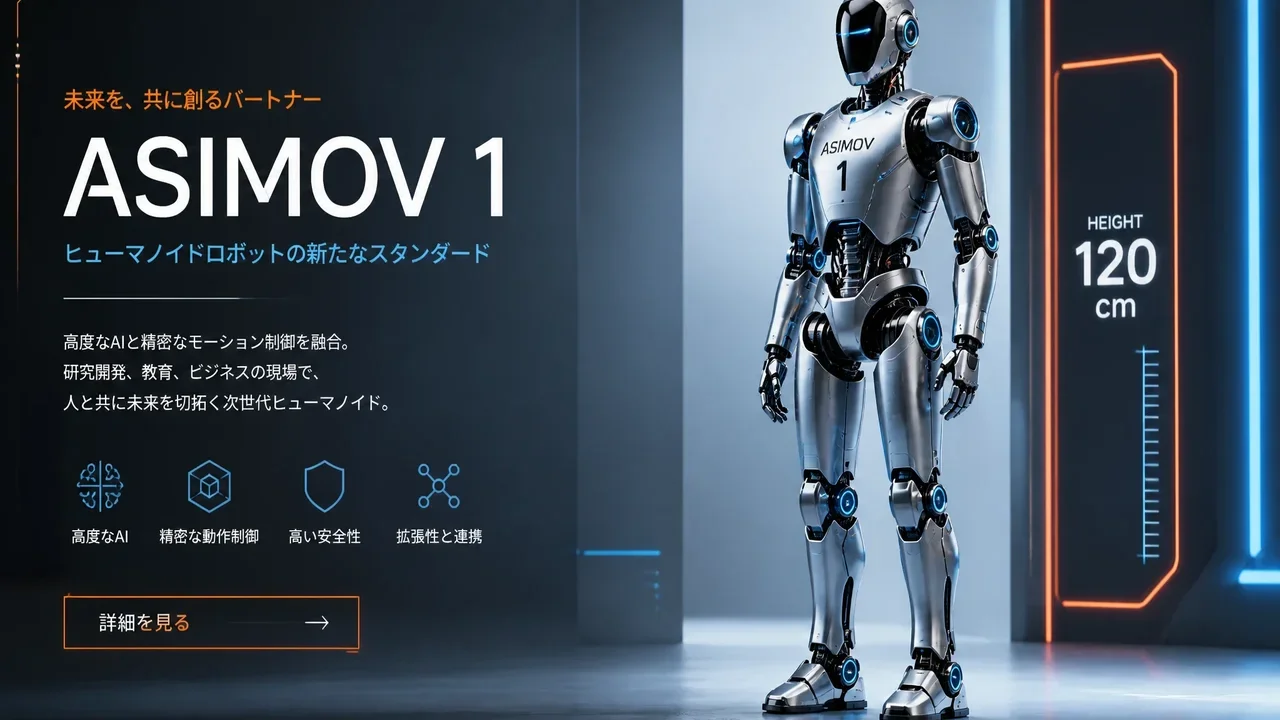
【2026】Asimov 1 Complete Guide — The $15,000 Open-Source Humanoid Robot DIY Kit: Purchase, Assembly & Setup
"If I could build a humanoid robot from scratch..." — you've probably had that thought at least once.
Asimov 1, developed by Singapore-based Menlo Research, is the project that turns that dream into reality. It's a fully open-source humanoid robot — CAD data, PCB designs, and software are all publicly available. And most importantly, you can buy it as a DIY kit ($15,000 / ~¥2.4M).
This article covers everything from how to purchase the Asimov 1, to the skills and tools needed for assembly, and through to setup and operation — all explained clearly enough for beginners.
What You'll Learn from This Article
- What kind of robot Asimov 1 is (specs & features)
- How it compares to Unitree G1/R1 (which should you buy?)
- How to order the DIY kit (the $499 deposit process)
- What the batch system is (why you build in groups of 10)
- Skills, tools, and time required for assembly (50–100 hours)
- Setup steps after it arrives
- How to self-source parts (procure everything yourself)
- The Menlo Research ecosystem (simulation, AI integration)
What Is Asimov 1? The "Reference Humanoid" Philosophy
Asimov 1 is not a finished product sold off the shelf. It's a humanoid robot built as a "reference design."
In the words of Asimov Inc. (@asimovinc):
Asimov 1 is not a Unitree R1 competitor. It's a completely different animal. We built Asimov as a reference humanoid. Open source. Open BOM (bill of materials). Full right to repair. You can modify it. Customize it. Improve it. It's a starting point for the industry to build upon.
In other words:
- Unitree G1/R1 → Buy a "finished product" and run it (ready out of the box)
- Asimov 1 → Buy "blueprints + parts" and assemble it yourself (fully hackable)
| Comparison | Asimov 1 | Unitree G1 |
|---|---|---|
| Price | ~$15,000 (DIY Kit) | ~$16,000 (Complete) |
| Height | 120cm | 127cm |
| Weight | 35kg | 35kg |
| Degrees of Freedom | 25+2 DOF | 23 DOF |
| Open Source | Fully OSS (CAD, PCBs, software — all of it) | Partial only |
| Assembly | Required (50–100 hours) | Not required (complete unit) |
| Modification Freedom | Complete freedom | Limited |
| Repair | Self-repairable (schematics available) | Manufacturer-dependent |
| Batch System | Groups of 10, simultaneous assembly | None |
Which should you choose?
- "I just want to run a robot" → Unitree G1/R1 (complete unit)
- "I want to understand every part of the robot" / "I want to modify it" → Asimov 1 (DIY Kit)
- "I need a research / education / development platform" → Asimov 1 (OSS + full simulation)
Core Specs in Detail
Here are the official specs for Asimov 1.
| Item | Value |
|---|---|
| Height | 123cm |
| Weight | 35kg |
| Degrees of Freedom (DOF) | 25 actuators + 2 passive |
| Legs | 6 DOF × 2 + toe × 2 |
| Arms | 5 DOF × 2 (shoulder pitch/roll/yaw, elbow, wrist yaw) |
| Torso | 1 DOF waist yaw, 10W 4Ω speaker, 6-axis IMU |
| Head | 2 DOF neck (yaw/pitch), 4-mic array, 2MP monocular camera |
| Peak Torque | 120 Nm |
| CAN Bus | 5 × 1Mbps + 1 × 500kbps |
| Onboard Computers | Raspberry Pi 5 (media/network) + Radxa CM5 (motion control) |
| Structural Materials | CNC-machined 7075 aluminum + MJF PA12 nylon 3D prints |
| License | CERN-OHL-S-2.0 (Open Hardware) |
Expected Load Capacity (Strength Tests)
| Movement | Load |
|---|---|
| Squat | 5kg |
| Bicep Curl | 15kg per arm |
| Lateral Raise | 18kg per arm |
How to Buy: DIY Kit Reservation Steps
To purchase an Asimov 1, you reserve the "Here Be Dragons Edition" DIY kit.
Step 1: Pay the Deposit on the Official Site
- Visit asimov.inc/diy-kit
- Click the "PRE-ORDER $499 DEPOSIT" button
- Pay the $499 (~¥80,000) deposit
- The remaining balance (~$14,501) is paid before shipping
Note: The deposit is not fully non-refundable (check whether cancellation is possible before shipment).
Step 2: Get Assigned to a Batch
What makes Asimov 1 reservations unique is the batch system. Every 10 reservations form a single batch, and shipping and assembly happen simultaneously.
Benefits of the batch system:
- You've got peers building at the same time (connected with 10 batch-mates via Discord)
- You hit the same walls and solve them together
- Live-streamed debugging (the Menlo Research team joins in)
- Your batch-mates become your future development collaborators
True to the name "Here be Dragons," it's a mechanism for tackling a challenge no one has done before — not alone, but as a group of 10 plus the dev team.
Step 3: Wait for Shipping (Summer 2026 ~)
The first batch is targeting shipment in Summer 2026 (around August–September). Nearly $1M in deposits came in within about 30 days of reservations opening, so demand is extremely high.
Price Breakdown
Asimov 1's target price is $15,000. This aims to be an at-cost offering with no profit margin built in.
| Category | Cost | Breakdown |
|---|---|---|
| Body (Structure + Actuators) | $14,000 | Actuators (low volume) $7,000 / Chassis & exterior $7,000 |
| Boards & Electronics | $818 | Edge PC, motion control board, networking, power distribution |
| Battery & Certification | $830 | Battery $170 + certification costs $660 |
| Packaging & Peripherals | TBD | Spare parts, documentation, shipping |
As a point of reference, self-sourcing all parts brings the BOM cost to roughly $16,000. The kit is about $1,000 cheaper (volume discount effect).
What's in the Kit: Included vs. Not Included
Here's a breakdown of what the Asimov 1 DIY Kit includes — and what it doesn't.
| Category | Included | Not Included |
|---|---|---|
| Hardware | All BOM parts (unassembled), power & cables, spare parts | Tools, work gloves |
| Computers | Edge board (Raspberry Pi 5), Motion Control board (Radxa CM5), Network board, Power distribution board | 4G/5G module |
| Sensors | Monocular camera, IMU, mic array, speaker, motor joint state sensors | Lidar, 360° cameras, and other premium sensors |
| Safety | Battery, wireless E-Stop, safety guidelines | — |
| Documentation | Quick-start guide, manual, DIY videos | — |
| Hands | None (not yet implemented) | Not supported at this time |
Important note: Asimov 1 does not include hands. The current configuration covers legs, torso, and arms — dexterous manipulation is waiting on future updates. Community-built hands are also an option.
What You Need for Assembly
Required Skills
Menlo Research is honest about this: "Assembling Asimov 1 is comparable in complexity to servicing a car. This is not a weekend project."
- Mechanical knowledge: Torque management for screws, understanding tolerances, handling CNC/3D-printed parts
- Electrical knowledge: CAN bus wiring, power management, motor driver configuration
- Software knowledge: ROS 2, Python, Linux (Raspberry Pi / Radxa setup)
If you've "done an oil change on your car at home," you can get started without issues. For a complete beginner, the bar is honestly quite high.
Required Tools
The kit doesn't include tools. You'll need to supply the following yourself:
- Hex key set (metric)
- Torque wrench (for tightening to specified torque values)
- Phillips screwdrivers (various sizes)
- Side cutters / wire strippers
- Multimeter (for electrical verification)
- Anti-static work mat (recommended)
- PC (Ubuntu recommended, for ROS 2 environment setup)
Assembly Time
50–100 hours is the ballpark. The first milestone isn't "walking" — it's "getting to the point where you can safely power it on." From there, tuning and software setup take even more time before you can actually get it moving.
Menlo Research's recommended schedule:
- Mechanical Assembly: Assemble parts, build the body with proper torque management (30–50 hours)
- Electrical Wiring: Wire up CAN bus, power, sensors (10–20 hours)
- Verification: Power-on checks, E-Stop operation verification, individual motor response tests (5–10 hours)
- Software Setup: ROS 2, firmware, simulation environment (5–20 hours)
Setup Instructions (Software)
Once physical assembly is complete, it's time for software configuration.
1. Clone the Repository from GitHub
git clone https://github.com/asimovinc/asimov-1.git
cd asimov-1
2. Set Up the Simulation Environment
Asimov 1 supports MuJoCo-based physics simulation. You can train walking policies in simulation before running them on the actual robot.
# Simulation models are in the sim-model/ directory
cd sim-model
# MuJoCo setup (Python)
pip install mujoco
python -c "import mujoco; print('MuJoCo ready')"
3. Set Up the ROS 2 Environment
Asimov 1's control system is ROS 2-based. The following setup is required:
# Install ROS 2 Humble or the latest version
sudo apt install ros-humble-desktop

# Build the Asimov 1 ROS 2 packages
cd ~/ros2_ws
colcon build --packages-select asimov_bringup
source install/setup.bash
4. First Power-On
Important: Always perform the first power-on with the E-Stop connected.
- Connect the battery (or AC power)
- Confirm that the Raspberry Pi 5 boots up
- SSH into the Raspberry Pi:
ssh pi@asimov.local - Check the motion control board (Radxa CM5) firmware
- Verify CAN communication for each motor:
cansend can0 000# - Manually test each joint one at a time
5. Apply Walking Policy
Asimov 1 ships with basic walking policies pre-configured:
# Start basic walking
ros2 launch asimov_bringup walk.launch.py
From here, you enter the phase of training your own walking policies with reinforcement learning, or tuning parameters to match your modifications.
The Full Scope of Open Source
The Asimov 1 GitHub repository (github.com/asimovinc/asimov-1) publicly hosts all of the following:
| Directory | Contents |
|---|---|
| mechanical/ | CAD data (CNC-machined 7075 aluminum + MJF PA12 nylon 3D prints) |
| electrical/ | Motion Control Board v0.1.4 design files, wiring diagrams |
| sim-model/ | MuJoCo physics simulation model |
| scripts/ | Build scripts / fabrication manifests |
| assets/ | Images / media files |
The BOM (Bill of Materials) is also publicly available, so you can source every part yourself and build from scratch: Asimov 1 BOM
Official documentation: docs.menlo.ai/asimov/1
The Menlo Research Ecosystem
The true value of Asimov 1 goes beyond the hardware. The entire ecosystem Menlo Research provides is what matters.
- Simulation Environment: MuJoCo-based — train walking policies
- Menlo Platform: The robot intelligence layer (under development)
- Intelligence Layer: LLM integration / AI agent orchestration
- Community: Discord, forums, batch system
As Asimov's CEO puts it, "Our bet is on the ecosystem." The goal isn't to build the best hardware — it's to provide a platform where the entire community can advance robot intelligence together.
Frequently Asked Questions (FAQ)
Q: Can I assemble it without any programming experience?
It'll be tough. On top of 50–100 hours of assembly, you need foundational knowledge of ROS 2, Python, and Linux. Both the mechanical skills of car maintenance and the software skills to write Python scripts are required.
Q: Can I order it from Japan?
Yes. Pay the $499 deposit on the official site to reserve. Menlo Research will provide guidance on shipping destinations before shipment.
Q: Can I buy a pre-assembled (complete) unit?
At this time, only the DIY kit is available. Asimov 1 is a project where "building it yourself" is part of the value. If you absolutely need a complete unit, consider the Unitree G1/R1.
Q: Are hands (grippers) included?
No. Asimov 1 does not currently include hands. You'll need to build your own through the community or wait for future updates.
Q: How much workspace do I need?
The robot itself is a compact 120cm, but during assembly you'll want at least one table's worth of space (roughly 2m × 1m) to spread out parts.
Q: What's the battery runtime?
The spec sheet doesn't specify, but for a battery powering a 35kg robot, standard operation is estimated at roughly 30 minutes to 1 hour. Tethered operation via AC power is also possible.
Q: Is there a warranty?
Being a DIY kit, there's no warranty in the conventional consumer-product sense. However, you have support from the batch community and the Menlo Research team.
Summary: Who Is Asimov 1 For?
Asimov 1 is not a product for everyone. But if any of the following describe you, it may be the best choice out there.
- Researchers and students who want to understand robotics from the ground up
- Developers who want to freely modify and customize a humanoid robot
- AI engineers who want to test LLM / reinforcement learning integration on a real robot
- Educators looking for a teaching platform at universities and research labs
- Former Unitree users frustrated by repair difficulties and modification limits
On the other hand:
- Not suitable for those who "just want it working out of the box"
- You need to be reasonably comfortable with both software and hardware
- $15,000 (~¥2.4M) is steep for an individual, but dramatically cheaper than competitors for research purposes
Asimov 1 offers an experience that is less about "buying a robot" and more about "making the robot your own." Sharing the difficulties in groups of 10, building a humanoid that's truly yours in every sense — that's the essence of this project.
Check It Out Now
- Asimov 1 Official Site — specs, manuals, reservations
- GitHub Repository — CAD, PCBs, software — everything included
- Official Documentation — assembly guide, BOM
- Asimov 1 on X — latest updates
※ Information in this article is current as of July 2026. Prices and specs are subject to change. This article contains no affiliate links.
Related Articles
この記事をシェアする
Related articles
2026年7月19日
Agents-A1 (35B MoE) Complete Guide 2026: Why a Small-Parameter Model Outperforms Giants in Agent Tasks

2026年7月19日
[2026] How to Dramatically Improve AI UI Generation with component.gallery! A Practical Guide to the Component Terminology Encyclopedia

2026年7月19日
Agentic Engineering 2026: Coined by Karpathy — How Google Agents CLI Is Transforming Production Development
2026年7月19日
12 Free AI Agent Courses Recommended for 2026: Learn from the World's Top Instructors
2026年7月18日
【2026】Qwen3.6-35B Genesis Hermes GGUF Complete Guide: Running an Uncensored Multimodal MoE on Your Local PC
2026年6月11日
2026 Overseas Hosting Comparison: WP Engine vs SiteGround vs Hostinger vs Cloudways