Summary
In July 2026, a model that overturns that assumption arrived: Agents-A1. With only 35B parameters (MoE), it's "compact" compared to giant AIs (hundreds of B to trillions), yet it outperforms GPT-5.5 and DeepSeek-V4 in science-paper-level tasks and long-horizon search/research work.
Agents-A1 (35B MoE) Complete Guide 2026: Why a Small-Parameter Model Outperforms Giants in Agent Tasks
"Fewer parameters means worse performance" — do you think so?
In July 2026, a model that overturns that assumption arrived: Agents-A1. With only 35B parameters (MoE), it's "compact" compared to giant AIs (hundreds of B to trillions), yet it outperforms GPT-5.5 and DeepSeek-V4 in science-paper-level tasks and long-horizon search/research work.
In this article, we break down this model released by InternScience — in beginner-friendly terms, with benchmark comparison tables — to show exactly how impressive it is.
Here's what you'll learn:
- What Agents-A1 actually is
- How it stacks up against famous models (Qwen, Kimi, DeepSeek, GPT-5.5)
- In which scenarios it truly shines
- How you can try it yourself
What Kind of Model Is Agents-A1?
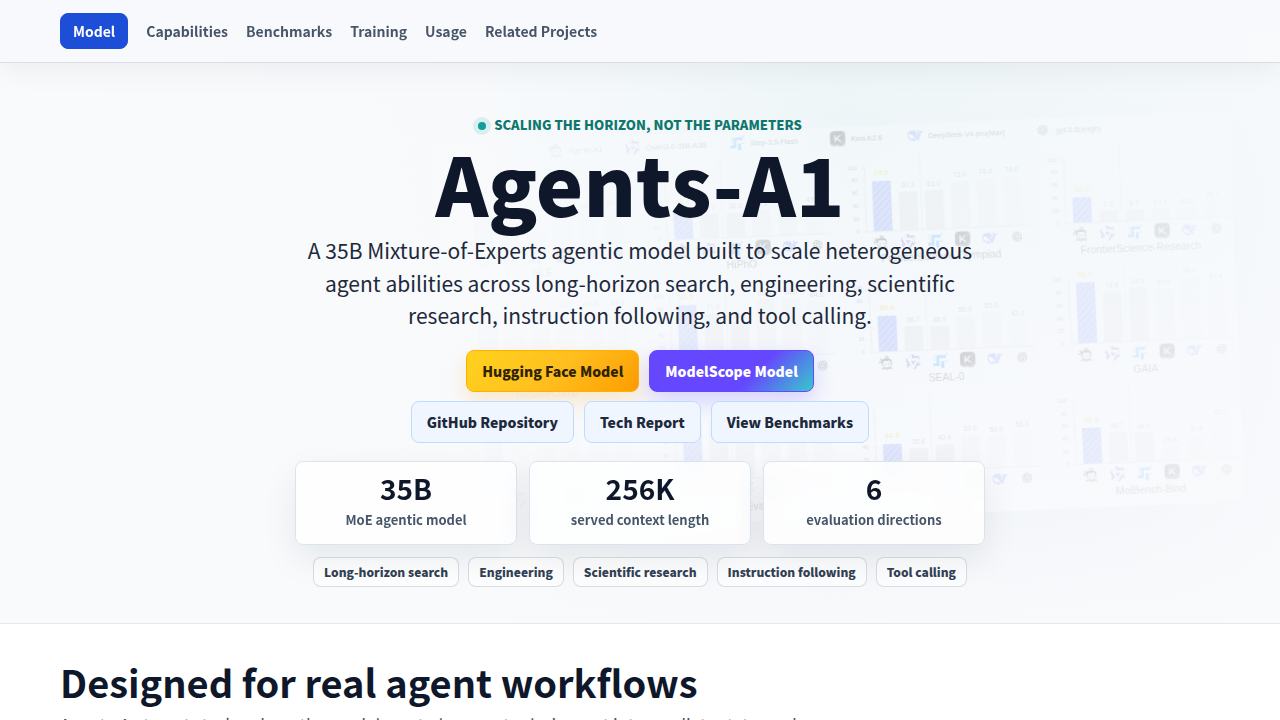
In one sentence: it's a 35B-class Mixture-of-Experts model built specifically for agents — AIs that plan on their own, use tools, and complete tasks.
It's developed by InternScience(an international collaborative research team). The tagline is"SCALING THE HORIZON, NOT THE PARAMETERS".
In other words, instead of "making the model bigger to do everything at once," it was trained specifically for agent capabilities: planning, tool use, long context, and instruction following.
Basic Specs
| Item | Details |
|---|---|
| Parameters | 35B (MoE: Mixture-of-Experts) |
| Context length | Up to 256K (~250K characters) |
| Base | Qwen3.5-MoE family |
| Capabilities | Text generation, VLM (image understanding), agent, tool calling |
| License | Apache-2.0 (commercial use allowed) |
| Release date | July 15, 2026 (updated) |
| Distribution | Hugging Face / ModelScope |
Since it's Apache-2.0, you can use it freely, including commercially — a big plus.
What Makes It Impressive: 4 Capabilities
The official site highlights these four strengths of Agents-A1:
1. Agentic reasoning
It breaks complex goals into executable small steps, plans procedures in advance, and can change strategy while observing intermediate results.
2. Tool use
It can use function calling and external tools like APIs, code execution, search engines, and task environments.
3. Long context
It maintains coherence, memory, and multi-step state even with long conversations and long documents (up to 256K).
4. Instruction following
From scientific research prompts to structured tool operations, it follows detailed constraints across domains.
Benchmark Deep Dive
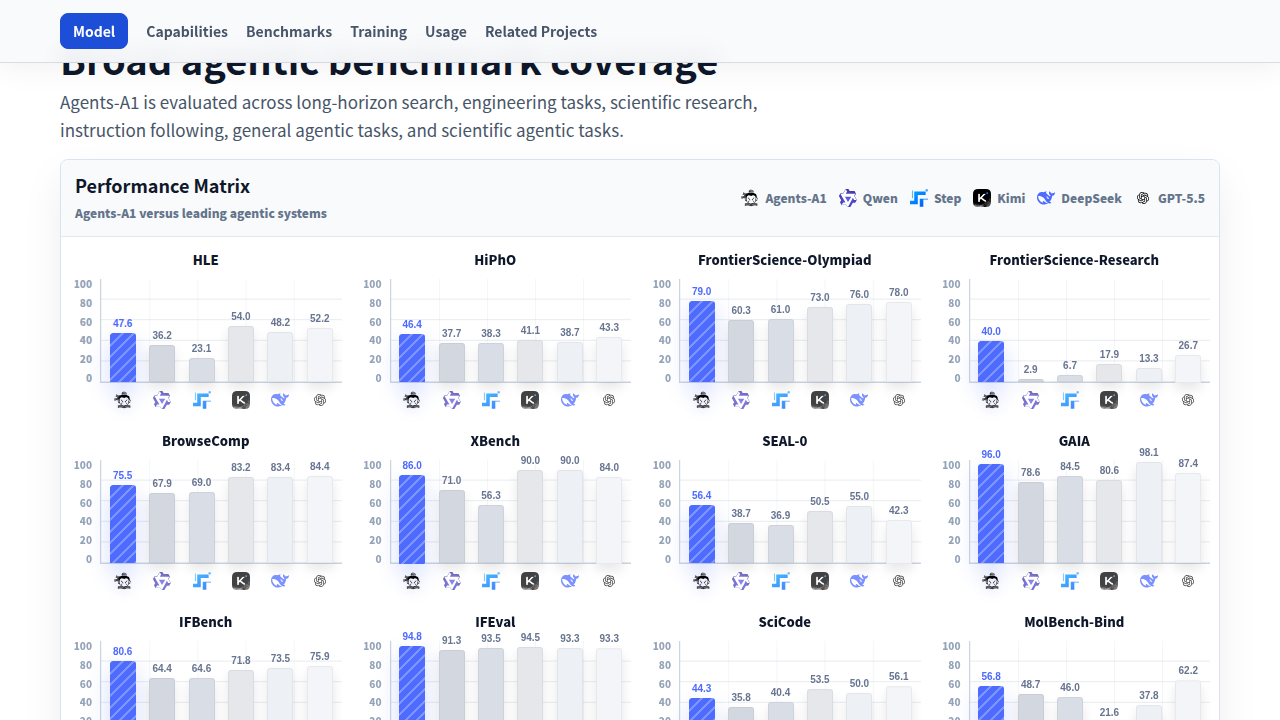
The real "wow" shows up in the numbers. Here's the Agents-A1 vs. 5 major models comparison published on the official site.
| Benchmark | Agents-A1 | Qwen3.6-35B | Step-3.5 | Kimi-K2.6 | DeepSeek-V4 | GPT-5.5 |
|---|---|---|---|---|---|---|
| HLE (Hard Reasoning) | 47.6 | 36.2 | 23.1 | 54.0 | 48.2 | 52.2 |
| HiPhO (Physics Olympiad) | 46.4 | 37.7 | 38.3 | 41.1 | 38.7 | 43.3 |
| FrontierScience-Olympiad | 79.0 | 60.3 | 61.0 | 73.0 | 76.0 | 78.0 |
| FrontierScience-Research | 40.0 | 2.9 | 6.7 | 17.9 | 13.3 | 26.7 |
| BrowseComp (Web Research) | 75.5 | 67.9 | 69.0 | 83.2 | 83.4 | 84.4 |
| XBench | 86.0 | 71.0 | 56.3 | 90.0 | 90.0 | 84.0 |
| SEAL-0 | 56.4 | 38.7 | 36.9 | 50.5 | 55.0 | 42.3 |
| GAIA (General Agent) | 96.0 | 78.6 | 84.5 | 80.6 | 98.1 | 87.4 |
| IFBench (Instruction Following) | 80.6 | 64.4 | 64.6 | 71.8 | 73.5 | 75.9 |
| IFEval (Instruction Following) | 94.8 | 91.3 | — | — | — | — |
Why Is It This Good: 3 Key Points
Point 1: Dominant on FrontierScience-Research
On science researchtasks,Agents-A1 (40.0) scores 1.5× GPT-5.5 (26.7) and 13× Qwen (2.9). Despite being based on the same 35B-class Qwen, the gap is huge — proof that agent-focused training works.
Point 2: Outstanding instruction following (IFBench / IFEval)
It beats GPT-5.5 and DeepSeek at following structured instructions — ideal for complex tool-driven workflows.
Point 3: Small yet top-tier in specific domains
It's close to GPT-5.5 (52.2 / 43.3) even on hard reasoning like HLE (47.6) and HiPhO (46.4). Focusing on "agent capability" instead of raw parameter count is paying off.
Assessment: Pros and Cons
Pros
- Runs on modest GPUs: at 35B class, easier to run than giants
- Apache-2.0 — free for commercial use
- Top-tier performance in science, research, and instruction following
- Supports 256K long context
Cons
- Slightly behind Kimi and DeepSeek on web research (BrowseComp) and XBench
- Beginner-friendly "how-to-use" guides are still developing
- Not Japanese-specialized; built by a China-based team, so Japanese examples can be scarce
How to Use It
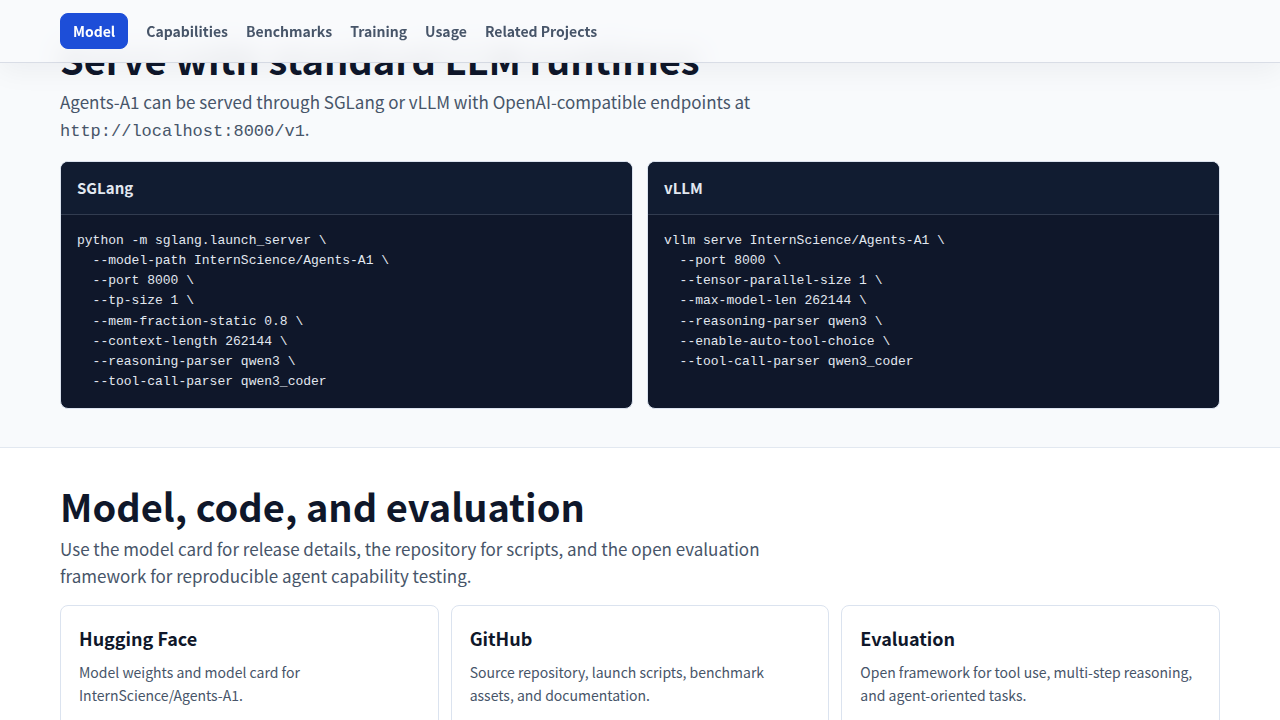
The official site's Usage section shows local and cloud execution examples. In general:
- Download from ModelScope / Hugging Face
- Load with a compatible inference engine (e.g., vLLM)
- Connect to an agent framework (with function calling support)
For beginners, the easiest path is a cloud notebook environment (e.g., ModelScope's "Quick Notebook development").
Recommended Learning Paths
Route A: Try it first (Beginner)
- Open the model page on ModelScope
- Try it immediately in a notebook environment
- Ask it to do a simple "research task" and watch how it works
Route B: Use it as an agent (Intermediate)
- Prepare an environment with function calling
- Give it search and code execution as tools
- Hand it a long research task
Route C: Full-scale use (Advanced)
- Integrate it into your own workflow
- Use it for scientific research and document processing
- Combine it with other models based on the task
Questions Readers Ask
Q1. Is Agents-A1 free to use?
The model itself is Apache-2.0, so downloading and using it is free. However, running it requires GPU resources (cloud = pay-as-you-go).
Q2. Does it work in Japanese?
Since its base is Qwen, it's strong in Chinese and English and understands Japanese too, but it's not Japanese-tuned.
Q3. How is it different from regular chat AI (like GPT)?
Instead of "producing one answer," it's designed to run its own loop: plan → use tools → check results → next step — agent-style.
Q4. Can I run it on my own PC?
With a high-end GPU (24GB+ VRAM recommended; quantization makes it lighter), yes. Otherwise, cloud is the practical choice.
Q5. Can I integrate it into a commercial product?
Apache-2.0 means yes, including commercial use (but check each benchmark's source/restrictions).
Q6. How should I divide tasks between models?
Use Agents-A1 for "deep scientific research, long-horizon search, strict instruction following" and Kimi/DeepSeek-family models for "general web search and latest information." Split by use case.
Summary
Agents-A1is a standout model — compact at 35B parameters, butspecifically trained for agent capabilities (planning, tools, long context, instruction following).
- 1.5× GPT-5.5's score on science "research" tasks
- Beats major models on instruction following (IFBench)
- Apache-2.0 — free for commercial use
The era of "parameter count = performance" is over. This is a perfect example of "what you train for" deciding the outcome. Start by trying it on ModelScope or Hugging Face and see its power for yourself.
This article is for informational purposes. Figures are based on benchmarks from the official project site (published July 2026). Check each official site for the latest scores.Recommended Reading
- DS4Flash (DeepSeek V4 Flash) Local Complete Guide: Maximizing 96–128GB VRAM
- SWE-1.7 Complete Guide: Devin-Powered AI Engineer Coding at 1000 Tokens/sec
- Qwen3.6-35B Genesis Hermes GGUF Complete Guide
- AI Model API Pricing Comparison 2026: ChatGPT vs Claude vs Gemini vs DeepSeek vs MiMo
- Xiaomi MiMo API Complete Guide
Related reading
- Ornith-1.0 Complete Guide 2026: The MIT-Licensed Open-Source AI Coding Model That Surpasses Claude Opus
- Laguna S 2.1 Complete Guide: The 118B MoE Open-Weight Coding Model That Beats Models Up to 25× Larger (Full Benchmark Comparison)
- 【2026】Qwen3.6-35B Genesis Hermes GGUF Complete Guide: Running an Uncensored Multimodal MoE on Your Local PC
Share this article
Related articles
Aug 12, 2026
Grok 4.6 Complete Guide 2026: The Latest Frontier-Intelligence Model at the Same Price, Compared with Official Benchmarks
Jul 28, 2026
Kimi K3 Complete Guide: The 2.8T World's Largest Open Model and the 0.18B Tiny Version That Runs on Potato PCs (2026)
Sep 2, 2026
Qwen3.8-Max-0902 Guide 2026: The 2.4T-Parameter MoE Upgraded with Coding & Cowork Post-Training
Aug 14, 2026
dots3-note Preview Complete Guide 2026: RedNote's 280B MoE Model That Goes Head-to-Head with DeepSeek V4 Flash
Aug 29, 2026
Ornith-1.5-35B-A3B Guide 2026: Run the Qwen3.6-Beating MoE Coding Model Locally (Quantization & Hardware)
Sep 16, 2026
SWE-1.7 Complete Guide 2026: The AI Engineer with Devin DNA That Codes at 1000 Tokens/sec, Approaching Opus 4.8