Summary
On July 21, 2026, the AI coding world was abuzz. Laguna S 2.1, released by Poolside, posted scores on par with or better than models 14–25× its size.
Laguna S 2.1 Complete Guide: The 118B MoE Open-Weight Coding Model That Beats Models Up to 25× Larger (2026)
"Want a powerful open-weight coding model that beats models 25x its size, without breaking your hardware budget?"
"A 118B-parameter model beat a 1.6-trillion (1,600B) parameter model at code generation."
On July 21, 2026, the AI coding world was abuzz. Laguna S 2.1, released by Poolside, posted scores on par with or better than models 14–25× its size.
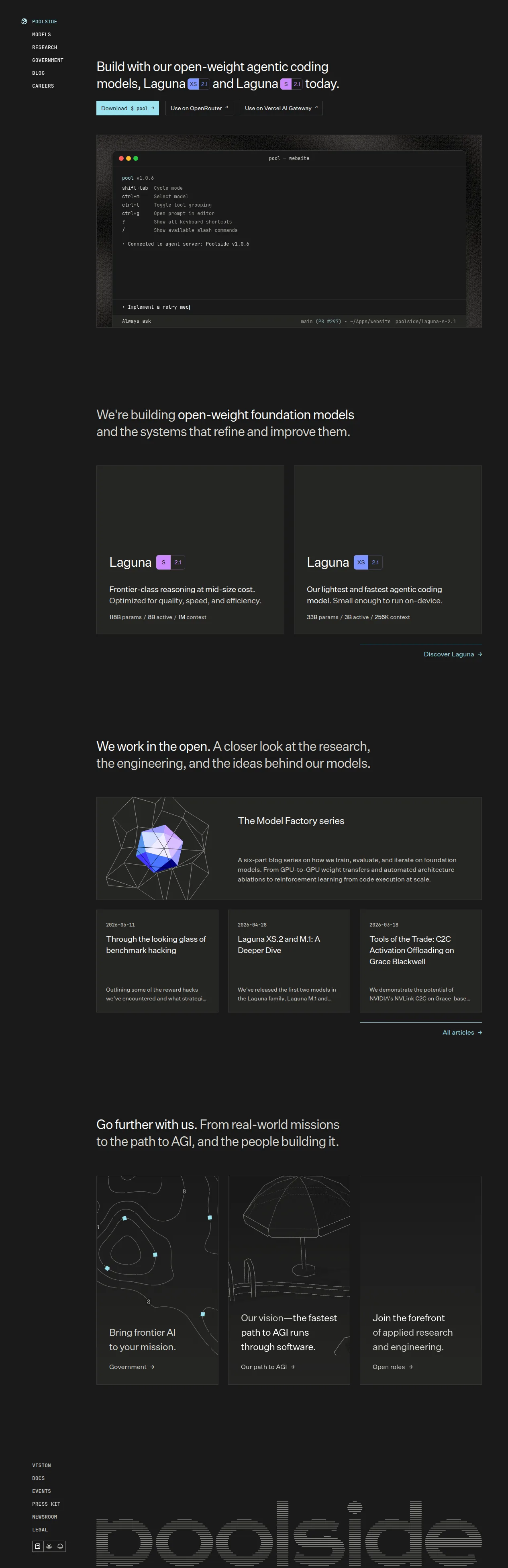
↑ Screenshot (scroll to view full) Poolside.ai top page
Laguna S 2.1:
- 118B total / 8B active (MoE)
- Up to 1M token context window
- Thinking / no-thinking mode toggle
- Fully open under the Apache-compatible OpenMDW-1.1 license (open-weight)
- Runs on a single NVIDIA DGX Spark
A model drawing attention from solo developers to enterprises.
In this article, we organize all official benchmark scores into accurate comparison tables and explain in beginner-friendly terms "why a small model is strong" and "when to use it."
Here's what you'll learn:
- Laguna S 2.1 specs and features
- Benchmark comparison with other latest models (6 metrics)
- The effect of "thinking mode" (how much it improves)
- How to run locally and cloud API pricing
- Who it's for / who it's not for
Laguna S 2.1 Basic Specs
| Item | Spec |
|---|---|
| Model name | Laguna S 2.1 |
| Total parameters | 118B |
| Active parameters | 8B per token |
| Architecture | MoE (Mixture-of-Experts) |
| Context | Up to 1M tokens |
| Thinking mode | Yes (thinking / no-thinking) |
| License | OpenMDW-1.1 (open-weight) |
| Published at | Hugging Face |
| Formats | BF16 / FP8 / INT4 / NVFP4 / GGUF / MLX |
| Training period | ~9 weeks (4096× H200 GPUs) |
"MoE"means not all parameters are used every time — only a fraction of experts activate depending on the input. So althoughtotal parameters are 118B, only 8B are actually used. That's the secret of "smart yet runs on small GPUs."
Benchmark Results (Official Scores, Full Comparison)
Poolside published 6 benchmarks, side by side across all models. Evaluated with pass@1 (average probability of correct on first try). Each model's max score adopted.
| Benchmark | Laguna S 2.1 (118B-A8B) | Tencent Hy3 (295B) | DeepSeek-V4-Pro-Max (1.6T) | Kimi K3 (2.8T) | Qwen 3.7 Max | Muse Spark 1.1 | Claude Fable 5 |
|---|---|---|---|---|---|---|---|
| Terminal-Bench 2.1 | 70.2 | 71.7 | 64.0 | 88.3 | 74.5 | 80.0 | 88.0 |
| SWE-Bench Multilingual | 78.5 | 75.8 | 76.2 | — | 78.3 | — | — |
| SWE-Bench Pro | 59.4 | 57.9 | 55.4 | — | 60.6 | 61.5 | 80.3 |
| DeepSWE | 40.4 | — | 9.0 | 69.0 | — | 53.3 | 70.0 |
| SWE Atlas (QnA) | 46.2 | — | 27.2 | — | — | 42.2 | — |
| Toolathlon Verified | 49.7 | — | 55.9 | — | — | 75.6 | — |
"—" means no official score published or not participated.
Point 1: Out-of-size strength on Terminal-Bench 2.1
| Rank | Model | Total params | Score |
|---|---|---|---|
| 1 | GPT-5.6 Sol | Undisclosed | 88.8 |
| 2 | Kimi K3 | 2.8T | 88.3 |
| 3 | Claude Fable 5 | Undisclosed | 88.0 |
| 10 | Hy3 | 295B | 71.7 |
| 11 | Laguna S 2.1 | 118B | 70.2 |
| 13 | DeepSeek-V4-Pro-Max | 1,600B | 64.0 |
| 14 | Inkling | 975B | 63.8 |
Notable: the 118B Laguna outscores giant models like 1,600B (DeepSeek) and 975B (Inkling). A 14–25× parameter gap, reversed.
Point 2: Top-class on SWE-Bench Multilingual
78.5%on multilingual software engineering tasks. Beats Qwen 3.7 Max (78.3%), higher than DeepSeek-V4-Pro-Max (76.2%) and Tencent Hy3 (75.8%).Overwhelming #1 in its size class.
Point 3: Crushing DeepSeek on DeepSWE
On the long-horizon DeepSWE: 40.4%vs DeepSeek9.0%. Tasks DeepSeek can barely solve, Laguna solves over 40% of the time. This is the fruit of Laguna's "work tenaciously over long periods" design philosophy.
Full Benchmark Transparency — What Is trajectories.poolside.ai?
With this release, Poolside fully publishes the trajectories of all evaluations.
🔗 https://trajectories.poolside.ai/
Traditional AI benchmarks usually publish only "final scores." Poolside is different. For each task, you can view/download the raw logs (trajectories) of "what steps the model took, which commands it ran, where it got stuck, and how it broke through."
Why This Matters
AI benchmarks have a serious problem called "reward hacking."
For example:
- Did the model truly solve it on its own?
- Or did it search the internet and copy-paste the answer?
- Was it just memorizing benchmark-specific quirks?
During development, Poolside itself found via LLM-as-a-Judge that over 50% of SWE-bench trajectories involved "finding answers online and fixing." They claim to have reduced this to under 2% by prompting "don't look at answers directly."
In other words, trajectories.poolside.ai is a place where you can verify the "credibility" of scores yourself.
What You Can See
- Full trajectories of all trials in each benchmark's final evaluation set
- All data for Terminal-Bench 2.1 / SWE-Bench Multilingual / SWE-Bench Pro / DeepSWE / SWE Atlas / Toolathlon
- Commands, edits, and test results the model made
- Verified by human expert evaluators
Not just "show the numbers" — "show how the numbers were reached." This is a concrete example of Poolside's "We work in the open" philosophy.
The Effect of "Thinking Mode" — How Much Does It Improve?
Laguna S 2.1 has two modes:
- no-thinking: immediate answer. Fast, cheap
- thinking: reasons internally before answering. Slower, smarter
Official data on "how much thinking mode improves":
| Benchmark | no-thinking | thinking | Improvement |
|---|---|---|---|
| Terminal-Bench 2.1 | 60.4% | 70.2% | +9.8pt |
| DeepSWE | 16.5% | 40.4% | +23.9pt |
| SWE-Bench Pro | 53.0% | 59.4% | +6.4pt |
DeepSWE improves by 23.9pt — thinking mode is especially effective for long-horizon tasks.
Why Is It "Small Yet Strong"?
The secret Poolside's research team revealed: "adding intelligence isn't the only answer."
"What we did with this model wasn't just adding smarts — it was improving behaviors that lead to more capable models: verify more, don't assume things are obvious, don't declare victory early, be persistent."
Specifically:
- Verification behavior: tests its own output
- Persistence: doesn't say "good enough" when tests partially pass
- Backtracking: doesn't give up two steps back; tries alternative approaches
- Long context: remembers "all prior work" with up to 1M tokens
These were achieved through training techniques (RL innovations). By training "how it works" instead of enlarging the model, out-of-size performance emerged.
Real Working Examples (3 Case Studies)
Case 1: Building a browser engine from an empty folder
Ask Laguna S 2.1 to "build a browser engine," and it constructs a working HTML/CSS rendering engine in 50 minutes and 181 steps with no human intervention. It ran headless Chromium itself, compared screenshots, and self-verified correct rendering.
Case 2: Optimizing Poolside's own harness
Run Laguna S 2.1 in an automatic loop and it speeds up Poolside's agent infrastructure by 5.2% and cuts memory allocation by ~70%.
Case 3: Rediscovering a 50-year-unsolved math problem
It independently discovered a proof of Erdős problem #397 (proposed 1975, unsolved) within its knowledge cutoff (November 2025). GPT-5.2 Pro first proved it in January 2026, but Laguna derived it on its own, uninfluenced.
How to Use It?
Method 1: Cloud API (easiest)
Available on OpenRouter:
- Free endpoint (256K context) available
- Paid dedicated endpoint (1M context):
- Input: $0.10 / 1M tokens
- Output: $0.20 / 1M tokens
- Cache read: $0.01 / 1M tokens
Also: Baseten, Vercel AI Gateway, Frontier Gateway
Method 2: Run locally
Runs on a single NVIDIA DGX Spark. Consumer GPUs (RTX 4090 etc.) may work with quantization (INT4 / NVFP4).
Supported inference engines:
- vLLM
- SGLang
- Ollama
- NVIDIA TRT-LLM (Blackwell)
Method 3: Via coding agents
Laguna S 2.1 works from these agents:
- pool (Poolside official, terminal-style)
- Hermes Agent (※caveats below)
- Kilo, OpenCode, OpenClaw, Cline, pi
For non-developers: chat.poolside.ai (no login, with web search)
Cautions
Tool-call instability in Hermes Agent etc.
Poolside admits: "third-party harnesses (like Hermes Agent's terminal tools) may struggle to comply with tool schema definitions." However, if the harness rejects invalid calls and retries, it fixes itself via in-context learning.
Nested tool calls
With tools that take JSON arrays as arguments (like Pi's edit tool), escaping can break.
Overthinking
On hard math problems, it may keep thinking for hours. "Thinking intensity control" is planned for the future.
Still early
First released July 21, 2026. Benchmarks are strong, but real-world evaluation is yet to come.
Questions Readers Ask
Q1: Is it free?
Yes. Try the OpenRouter free endpoint (256K context). Downloading weights from Hugging Face and running it yourself is also free (no license fee).
Q2: Can I use it commercially?
Published under the OpenMDW-1.1 license. Check the license text for commercial use (similar to typical open-weight, but with MDW-specific clauses).
Q3: Is it good at Japanese?
Optimized for English-based coding tasks. Japanese instructions work, but English tends to be more accurate.
Q4: What should I compare it with?
In the same size band, compare with Tencent Hy3 (295B)orDeepSeek-V4-Flash-Max (284B). Laguna is smaller, faster, and cheaper with equal-or-better coding performance.
Q5: Does it run on a local PC?
Officially supported on a single DGX Spark. On a typical gaming PC, INT4/NVFP4 quantization can manage, barely. 24–48GB VRAM recommended.
Q6: Is the API expensive?
On OpenRouter paid: $0.10 input, $0.20 output / 1M tokens.Compared to Claude or GPT at equivalent performance, it's1/10 or less.
Q7: When should I use thinking mode?
Complex bug fixes, long-horizon tasks, math proofs → thinking. Simple completions, fast responses → no-thinking.
Q8: What's different from other open models?
The "work tenaciously over long periods" design is the biggest difference. Many models stop when partially correct; Laguna keeps verifying to the end.
Summary — Should You Use Laguna S 2.1?
Conclusion: If you want cheap, local, high-quality coding AI, this is one of the strongest choices right now.
- 118B/8B MoE — one DGX Spark, or $0.10–$0.20 / 1M tokens in the cloud
- Crushes 1.6T DeepSeek on DeepSWE (40.4% vs 9.0%)
- Fully open-weight, deployable on your own server
- Thinking mode handles hard problems
Conversely, these people can wait:
- Those who want natural conversation in Japanese only (English-optimized)
- Those who only need instant responses (thinking mode is slow)
- Lightweight inference like mobile apps (the 33B XS 2.1 is better suited)
In the second half of 2026, the most "cost-effective and smart" open AI coding model. Run it on Hugging Face starting today.
"We're building open-weight foundation models."
Poolside's philosophy — putting models in everyone's hands. Laguna S 2.1 is the most practical fruit of that vision.
Information in this article is as of July 21, 2026. Benchmark scores based on Poolside's official announcement (2026-07-21). All evaluation trajectories are public at trajectories.poolside.ai.
Recommended Reading
- DS4Flash (DeepSeek V4 Flash) Local Complete Guide: Maximizing 96–128GB VRAM
- SWE-1.7 Complete Guide: Devin-Powered AI Engineer Coding at 1000 Tokens/sec
- Agents-A1 (35B MoE): Small-Parameter Model Analysis
- Qwen3.6-35B Genesis Hermes GGUF Complete Guide
- AI Model API Pricing Comparison 2026
Related reading
- Ornith-1.5-35B-A3B Guide 2026: Run the Qwen3.6-Beating MoE Coding Model Locally (Quantization & Hardware)
- 【2026】Xiaomi MiMo API Complete Guide: The Multimodal AI Model at the Same Price as DeepSeek
- Ornith-1.0 Complete Guide 2026: The MIT-Licensed Open-Source AI Coding Model That Surpasses Claude Opus
Share this article
Related articles
Jul 28, 2026
Kimi K3 Complete Guide: The 2.8T World's Largest Open Model and the 0.18B Tiny Version That Runs on Potato PCs (2026)
Jul 19, 2026
Agents-A1 (35B MoE) Complete Guide 2026: Why a Small-Parameter Model Outperforms Giants in Agent Tasks
Aug 12, 2026
Grok 4.6 Complete Guide 2026: The Latest Frontier-Intelligence Model at the Same Price, Compared with Official Benchmarks

Aug 14, 2026
dots3-note Preview Complete Guide 2026: RedNote's 280B MoE Model That Goes Head-to-Head with DeepSeek V4 Flash
Sep 16, 2026
SWE-1.7 Complete Guide 2026: The AI Engineer with Devin DNA That Codes at 1000 Tokens/sec, Approaching Opus 4.8
Aug 12, 2026
OpenCode 2.0 Complete Guide 2026: The Next-Generation AI Coding Agent Where TUI, Desktop, and Web Stay in Sync