Summary
In July 2026, Moonshot AI (maker of Kimi) released Kimi K3 — the world's first "3T-class (trillion-parameter) open-weight model."
Kimi K3 Complete Guide: The 2.8T World's Largest Open Model and the 0.18B Tiny Version That Runs on Potato PCs (2026)
"Curious how the world's largest open model — and its tiny 0.18B sibling — actually perform on ordinary hardware?"
"A 2.8-trillion-parameter giant AI" and "a tiny AI that runs in 700MB" actually share the same DNA.
In July 2026, Moonshot AI (maker of Kimi) released Kimi K3 — the world's first "3T-class (trillion-parameter) open-weight model."
At the same time, the community released a 0.18B (180M parameter) tiny version that runs on ordinary PCs.The compression ratio from 2.8T to 0.18B isabout 15,000× — while preserving the same architecture.

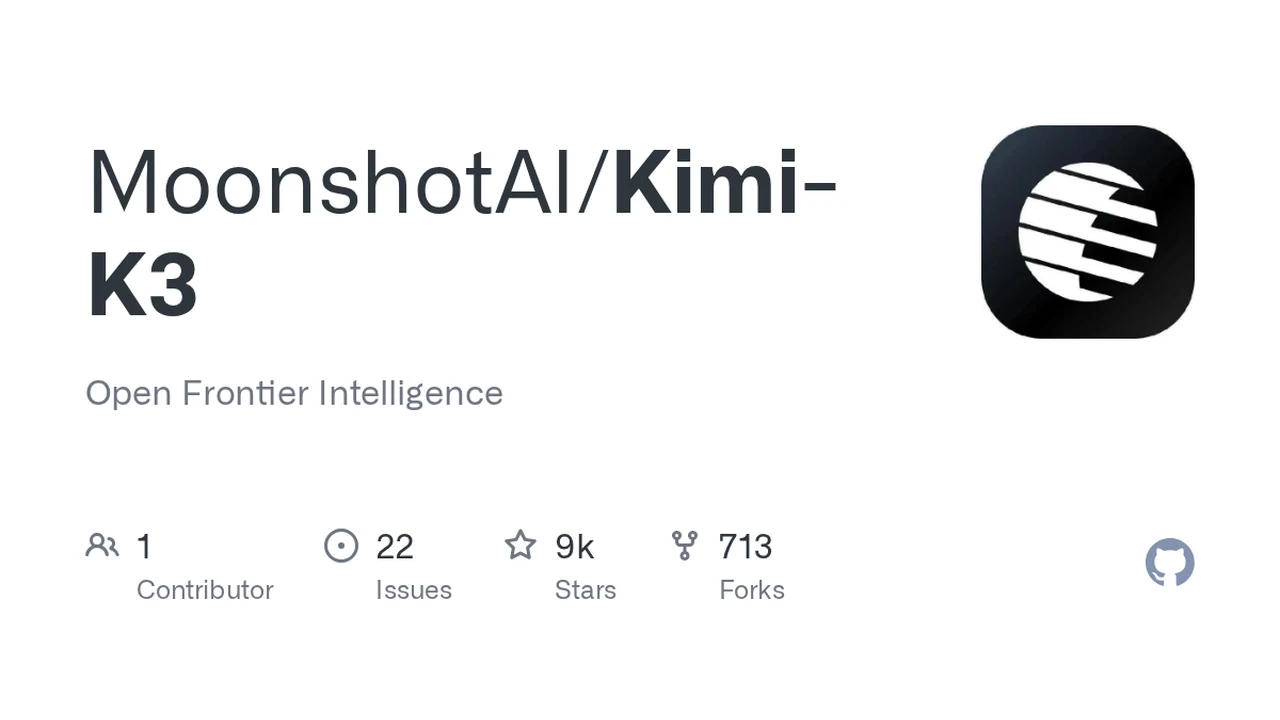
↑ Screenshot (scroll to view full) Kimi-K3 HuggingFace model card
In this article, we thoroughly explain both the official giant model and the community tiny version, based on real HuggingFace data and X posts.
Here's what you'll learn:
- Kimi K3 specs and strengths (with benchmark comparisons)
- Why the "giant model" and "tiny model" share the same DNA
- The technical mechanics of the 0.18B version and its actual running size
- Current status and cautions for running with llama.cpp etc.
- Which one fits you
What Is Kimi K3 (Official, 2.8T Version)?
Kimi K3 is an open-weight, natively multimodal agent model released by Moonshot AI. It's their flagship: it understands text, images, and video within the same model, with a 1M-token context window.
Basic Specs (from the official model card)
| Item | Spec |
|---|---|
| Total parameters | 2.8T (2,800B) |
| Active parameters | 104B per token |
| Architecture | MoE (Mixture-of-Experts) |
| Layers | 93 |
| Experts | 896 (2 shared) |
| Active experts per token | 16 |
| Attention | KDA (Kimi Delta Attention) + Gated MLA |
| Context | 1,048,576 tokens (1M) |
| Vision encoder | MoonViT-V2 (401M) |
| Quantization | MXFP4 weights / MXFP8 activations (quantization-aware training) |
| Modalities | Text, image |
| License | Kimi K3 License (open-weight) |
What Is the New "KDA" Attention?
The biggest technical feature is Kimi Delta Attention (KDA)andAttention Residuals (AttnRes).
- KDA: a new attention design that computes differences (deltas). Handles long contexts efficiently
- AttnRes: retains attention residuals (subtraction differences), preventing information degradation
- Stable LatentMoE: stabilizes the mechanism activating 16 of 896 experts
This achieves about 2.5× the scaling efficiency of Kimi K2 (previous generation).
Benchmarks (official scores)
| Benchmark | Kimi K3 | Claude Fable 5 | GPT-5.6 Sol | GLM-5.2 |
|---|---|---|---|---|
| Terminal-Bench 2.1 | 88.3 | 88.0 | 88.8 | 82.7 |
| DeepSWE | 67.5 | 70.0 | 73.0 | 46.2 |
| SWE-Marathon | 42.0 | 35.0 | 39.0 | 13.0 |
| BrowseComp | 91.2 | 88.0 | 90.4 | — |
| GPQA Diamond | 93.5 | 92.6 | 94.1 | 91.2 |
| FrontierSWE | 81.2 | 86.6 | 71.3 | 67.3 |
At 88.3% on Terminal-Bench 2.1, it's nearly level with GPT-5.6 Sol (88.8%). Top on SWE-Marathon at 42.0%. Performance on par with the world's frontier models.
What Is the "0.18B" Tiny Version? (Community)
According to X user @0x0SojalSec:
"A tiny Kimi-K3 that runs locally even on potato PCs.
- From 2.8T to 0.18B.
- 0.10B active.
- Same architecture.
- Same new attention design scaling.
- Same DNA, just shrunk.
- Compressed to 0.18B for testing.
- Currently fits in 700MB."
In other words: not just a truncated giant model — a "research/verification miniature" that preserves the architecture (KDA, MoE, AttnRes) while cutting parameters to the extreme.
Tiny Version Technical Specs (HuggingFace: inference-optimization/Kimi-K3-0.18B)
Based on the official model card (moonshotai/Kimi-K3), reduced as follows:
| Parameter | Original (2.8T) | Tiny (0.18B) |
|---|---|---|
| num_hidden_layers | 93 | 4 |
| hidden_size | 7168 | 512 |
| num_attention_heads | 96 | 4 |
| intermediate_size (dense) | 33792 | 1024 |
| moe_intermediate_size | 3072 | 256 |
| num_experts | 896 | 8 |
| num_experts_per_token | 16 | 2 |
| num_shared_experts | 2 | 1 |
| kv_lora_rank | 512 | 64 |
Important: What "Same DNA" Means
It's not just smaller — it maintains all layer types (KDA linear attention, MoE FFN, MLA full attention).
The tiny version's 4-layer structure:
- Layer 0: Dense FFN + KDA linear attention
- Layer 1–2: MoE FFN + KDA linear attention
- Layer 3: MoE FFN + MLA full attention
This lets you test the behavior of the new attention design (KDA) itself on ordinary hardware.
Actual Running Size
- Parameters: 0.18B (~0.10B active)
- File size: ~700MB (F32)
- License: MIT (the derivative is MIT, not the original Kimi K3 License)
- Verified: perplexity=2.12 (passes the target of 10.0 or below)
- Generation test: "According to all known laws of aviation..." — normal text generation confirmed
Another Miniaturization Route: GGUF Version (IQ1_S, 1bit/2bit)
X user @GrEarl converted the 2.8T model to GGUF format for llama.cpp.
- Source: 1,453.8 GiB (MXFP4)
- Output: 527.48 GiB (94-split GGUF)
- Effective bitrate: 1.63 bpw (sub-2bit)
- Method: routing experts at IQ1_S (~1.56bpw), everything else at Q4_K
But there's an important caveat (see "Current Limitations" below).
Current Limitations
Tiny version (0.18B) use cases
- Strictly for testing, development, and architecture verification
- Don't expect practical conversation or coding (0.18B has almost no knowledge)
- A technical demo to confirm "whether the Kimi K3 architecture runs on an ordinary PC"
GGUF version (IQ1_S) doesn't run yet
As @GrEarl himself states:
- Cannot be loaded by released llama.cpp
- Kimi K3 support is only in an unmerged PR (ggml-org/llama.cpp#26185)
- "Structural integrity verified, but actual loading and generation unverified"
- 2bit/1bit fixes and 1bit release in parallel
In other words, "practical operation of Kimi K3 on an ordinary PC" is not possible right now. Architecture verification (0.18B) is possible; the 2.8T GGUF is a technical proof-of-concept.
Required Hardware (by Size)
| Version | Size | Approx. memory | Use |
|---|---|---|---|
| 2.8T (official, MXFP4) | ~1.45TB | Multiple GPUs (dozens of H100-class) | Research, production API |
| GGUF IQ1_S | ~527GB | 600GB+ VRAM (requires unofficial branch) | Technical verification (not yet run) |
| 0.18B (tiny) | ~700MB | CPU ~4GB | Architecture verification, learning |
Questions Readers Ask
Q1. Does Kimi K3 run on an ordinary PC?
The 0.18B tiny version runs (~4GB CPU). But practical conversation isn't possible. The 2.8T main model and GGUF version don't run yet.
Q2. Why is 2.8T and 0.18B called "same DNA"?
Because it's shrunk while maintaining the layer types (KDA linear attention, MoE, MLA) and the new attention design. The architecture's behavior itself is the same.
Q3. Where can I get the 0.18B version?
HuggingFace: inference-optimization/Kimi-K3-0.18B (MIT license).
Q4. When will the GGUF version run?
Once llama.cpp PR (#26185) merges into official builds. Timeline TBD.
Q5. Is it good at Japanese?
The official 2.8T is multilingual. The 0.18B version has too few parameters to be practical.
Q6. Which model should I try?
If you're interested in the architecture, try 0.18B locally. For practical use, use 2.8T via API (Together AI etc.).
Q7. What's the license difference?
The 2.8T main model uses the "Kimi K3 License" (open-weight). The 0.18B derivative is MIT. The GGUF version inherits the Kimi K3 License.
Q8. What does it cost?
0.18B is free and local. The 2.8T API follows the provider's pricing.
Summary — How to Think About Kimi K3
Conclusion: Kimi K3 is both a historic milestone — the world's first 3T-class open model — and the beginning of an ecosystem where anyone can try the architecture.
- Official 2.8T: frontier-class performance, e.g. Terminal-Bench 88.3%
- Tiny 0.18B: verify the KDA architecture on an ordinary PC in 700MB
- GGUF version: technical proof-of-concept (not yet verified running)
Conversely, these people can wait:
- Those who want "smart Kimi" locally right now (0.18B isn't practical)
- Those who want to run it like a normal local LLM (Qwen, Llama, etc.) (GGUF not yet supported)
Kimi K3's true value lies in the next step: whether "giant model intelligence" can be brought down to a size anyone can touch. The 0.18B is the first step.
"You can actually load the new Kimi K3 architecture on normal hardware now."
That's the front line of local AI in 2026.
Information in this article is as of July 28, 2026. Benchmarks based on Moonshot AI's official announcement (Kimi-K3 model card). For the 0.18B version, see inference-optimization/Kimi-K3-0.18B; for the GGUF version, see GrEarl/Kimi-K3-GGUF-IQ1_S.
Recommended Reading
- DS4Flash (DeepSeek V4 Flash) Local Complete Guide: Maximizing 96–128GB VRAM
- SWE-1.7 Complete Guide: Devin-Powered AI Engineer Coding at 1000 Tokens/sec
- Agents-A1 (35B MoE): Small-Parameter Model Analysis
- Qwen3.6-35B Genesis Hermes GGUF Complete Guide
- AI Model API Pricing Comparison 2026
Related reading
-
Ling-3.0-flash in 2026: Ant Group's Next-Gen Hybrid MoE Explained (+ Medical "Sante" Cautions)
- 【2026】Qwen3.6-35B Genesis Hermes GGUF Complete Guide: Running an Uncensored Multimodal MoE on Your Local PC
- Ornith-1.5-35B-A3B Guide 2026: Run the Qwen3.6-Beating MoE Coding Model Locally (Quantization & Hardware)
- Agents-A1 (35B MoE) Complete Guide 2026: Why a Small-Parameter Model Outperforms Giants in Agent Tasks
Share this article
Related articles
Jul 21, 2026
Laguna S 2.1 Complete Guide: The 118B MoE Open-Weight Coding Model That Beats Models Up to 25× Larger (2026)
Jul 18, 2026
KTransformers Complete Guide: Run DeepSeek-R1 on 24GB VRAM with This CPU-GPU Collaboration Framework (2026 Guide)

Aug 10, 2026
Unsloth Muse Glimmer 30B Guide 2026: Run & Fine-Tune Meta's Agent Model on 18GB RAM
Aug 11, 2026
Unsloth Desktop Complete Guide 2026: The First Desktop App to Run and Train Models Locally
Aug 14, 2026
dots3-note Preview Complete Guide 2026: RedNote's 280B MoE Model That Goes Head-to-Head with DeepSeek V4 Flash
Jul 15, 2026
Bonsai 27B Guide 2026: The Ultra-Compressed AI Model That Runs on iPhone — Complete Breakdown