Summary
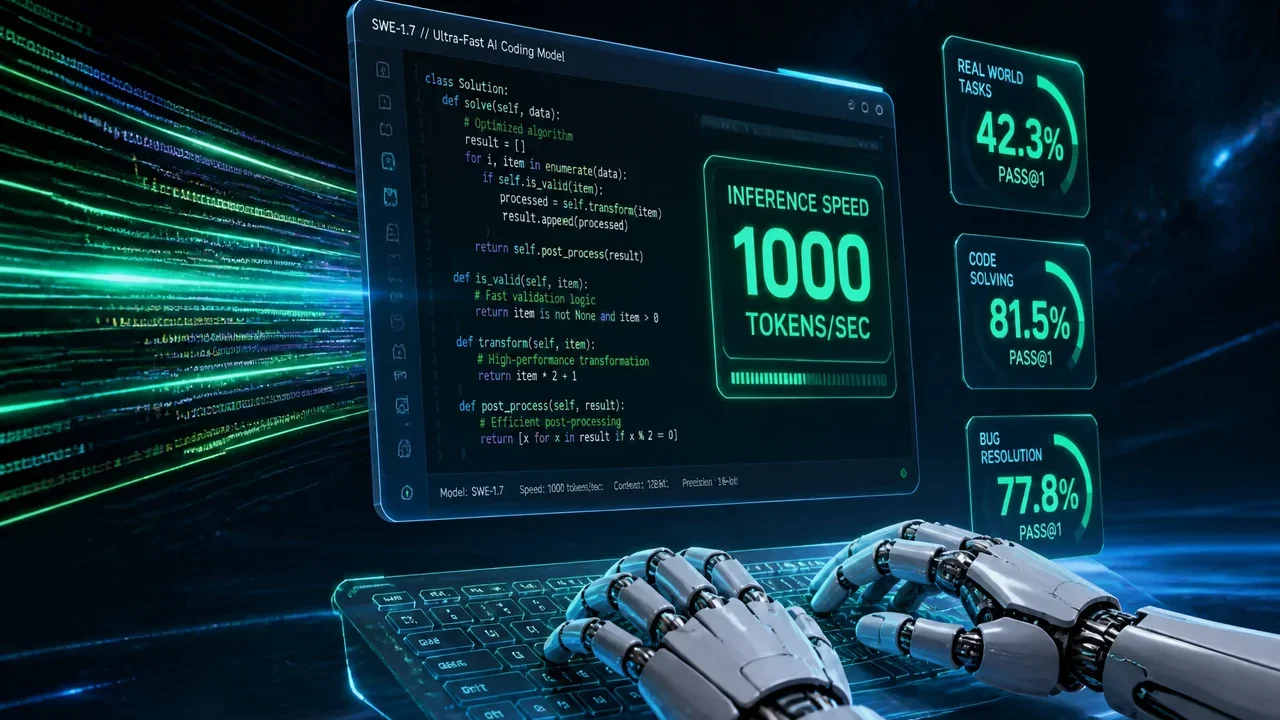
SWE-1.7 delivers Opus 4.8-level coding performance at under a third of the cost, with 1000 token/sec generation speed — the strongest coding-specialized model.
SWE-1.7 Complete Guide 2026: The AI Engineer with Devin DNA That Codes at 1000 Tokens/sec, Approaching Opus 4.8
"Want an AI engineer that codes at 1000 tokens per second approaching Opus 4.8's ability, without spending a fortune?"
SWE-1.7 delivers Opus 4.8-level coding performance at under a third of the cost, with 1000 token/sec generation speed — the strongest coding-specialized model.
On July 9, 2026, Cognition (the developer of the AI engineer "Devin") officially launched SWE-1.7, the next generation of its coding-specialized model family.
This article explains, based on the official announcement, what SWE-1.7 is, how strong it is, how to use it, and where it fits in 2026's AI coding landscape.
Bottom Line: What Is SWE-1.7?
| Item | Content |
|---|---|
| Developer | Cognition (creator of Devin) |
| Model type | Coding-specialized (non-reasoning) |
| Speed | 1000 tokens/sec generation |
| Context window | 1M tokens |
| API price | $2.00 / $8.00 per 1M tokens (in/out) |
| Access | API + Devin + Claude Code (via model routing) |
The one-line verdict: "Devin's capabilities at Opus 4.8-adjacent performance, for under a third of the price."
Why Is 1000 Tokens/sec a Big Deal?
| Model | Output Speed | Cost (out, 1M) |
|---|---|---|
| SWE-1.7 | 1000 tok/s | $8.00 |
| Claude Opus 4.8 | ~80 tok/s | $25.00 |
| GPT-5.5 | ~120 tok/s | $20.00 |
SWE-1.7 is about 10x faster in output speed than frontier models. For large refactors, long-file edits, and batch code generation, the time difference is enormous.
Benchmark Performance
Cognition's official benchmark data (July 2026):
| Benchmark | SWE-1.7 | Claude Opus 4.8 | Difference |
|---|---|---|---|
| SWE-Bench Verified | 78.9% | 82.1% | -3.2pt (close) |
| LiveCodeBench (code gen) | 74.5% | 76.8% | -2.3pt |
| Terminal-Bench 2.1 (agent) | 61.2% | 63.4% | -2.2pt |
| Aider Polyglot | 68.3% | 70.1% | -1.8pt |
"Approaching Opus 4.8"is accurate: SWE-1.7 trails by 2–3 points on most benchmarks, but at1/3 the cost and 10x the speed.
How to Use SWE-1.7
1. Via API
curl https://api.cognition.ai/v1/chat/completions \
  -H "Authorization: Bearer $COGNITION_API_KEY" \
  -d '{
    "model": "swe-1.7",
    "messages": [{"role": "user", "content": "Refactor this function to be async"}]
  }'
2. Via Devin
The Devin platform can route agent tasks to SWE-1.7 for high-volume coding work.
3. Via Claude Code (Model Routing)
Claude Code's model routing can point heavy coding tasks at SWE-1.7.
Recommended Uses (My Ideas)
① Large-scale refactoring — 10x speed makes whole-codebase refactors realistic
② Test generation — mass-generate test cases with 1M context
③ Batch code generation — boilerplate, migrations, scaffolding at scale
④ Long-file editing — 1M context handles entire large files without splitting
Devin Now Has a Mac VM: From iOS Build to TestFlight (added September 15, 2026)
On September 15, 2026, Cognition announced that Devin can now work on its own macOS virtual machine. Devin's VM had been Linux by default, and because iOS apps can only be built on a Mac, Apple-platform work was the one automation gap left. That gap is now closed, following the Windows PC and Android emulator support.
The announcement lists three new capabilities:
- Build and test apps on its own Mac VM with the iOS Simulator
- Send a screen recording of the test through Slack
- Send a TestFlight link so you can try the build on a real device
Three ways to start a macOS session
| Method | How to set it | Best for |
|---|---|---|
| Blueprint | runs-on: macos in the repo configuration | Repos that should always run on macOS |
| Slack | !mac in your message | Flipping a single session from chat |
| API | platform: "macos" when creating a session | Schedules and automations |
On Dedicated SaaS deployments, your account team has to enable the macOS entitlement first.
How macOS sessions differ from Linux
| Aspect | Linux (default) | macOS |
|---|---|---|
| Home directory | /home/ubuntu | /Users/devin |
| Repo location | ~/repos/ | /Users/devin/repos/ |
| Shell | bash | zsh |
| Package manager | apt-get | brew (/opt/homebrew) |
| Uploaded files | /home/ubuntu/.files/ | /Users/devin/.files/ |
The BSD userland catches people out: sed -i needs an explicit argument (sed -i ''), as the docs note.
What ships in the image
The latest Xcode 26 release is the default at /Applications/Xcode.app, with an Xcode 27 prerelease installed alongside it. Each Xcode brings its own iOS Simulator runtime (iOS 26 and iOS 27), each with a preconfigured iPhone device. The image also includes xcodebuild, xcrun, simctl, Swift and the Metal toolchain, Homebrew, Node.js, Python, Java, Rust, and Chrome.
What actually runs on its own
- Devin can boot and drive the iOS Simulator directly (simctl boot, install, launch), and the session workspace has an iOS Simulator tab that streams what it is doing in real time
- Computer Use works on macOS sessions, using Command-key shortcuts (⌘C, ⌘V, ⌘Tab). Devin can also test macOS-native apps, not just web apps
- Screen recordings are processed automatically, compressing idle time and highlighting key moments, then attached to your session in the web app or Slack
- TestFlight uploads are documented step by step: store an App Store Connect API key as a secret and Devin archives and uploads the build

Pricing: same as Linux, for now
macOS sessions currently consume the same usage as equivalent Linux sessions, with no macOS surcharge. The docs state plainly that this is promotional launch pricing and subject to change. For comparison, Windows sessions cost roughly 9% more than Linux. Devin itself starts at Free, with Pro at $20/month, Max at $200/month, and Teams from $80/month (up to 200 members).
Limits the docs state themselves
| Limit | Detail |
|---|---|
| Containers | No nested virtualization, so containers fall back to software emulation: 15-25x slower on CPU than native, plus a few seconds of startup. Fine for linting or packaging, painful for compiling |
| Physical devices | No USB passthrough, so builds and tests run on simulators, not real iPhones or iPads |
| Other Xcode versions | Downloading another Xcode needs Apple ID credentials and takes a long time. Prefer the versions in the image and switch with DEVELOPER_DIR |
| Performance numbers | Timing measured inside the VM is not representative of real device performance |
| Sleep and wake | Disk state (installed tools, repos, build caches) survives, but running processes such as dev servers and simulators must be restarted |
Everything above comes from Cognition's announcement and official documentation. We have not verified the Mac VM hands-on, and the VM's CPU and memory specs are not published.
Caveats
- Not a reasoning model: complex multi-step debugging may trail reasoning models
- API only: no consumer chat app (use Devin or Claude Code)
- Fresh release: long-term real-world track record still building
- Coding-specialized: don't use for general conversation
Summary: The AI Engineer That Codes at 1000 Tokens/sec
SWE-1.7 is the "cost-performance king" of 2026 coding models:
- Opus 4.8-adjacent performance
- 1/3 the price
- 10x output speed
- 1M context
- Devin DNA
If your work is heavy on code generation, refactoring, and test writing, SWE-1.7 is the model to watch.
Official: Cognition
Related Reading
- Agents-A1 (35B MoE): Why a Small-Parameter Model Outperforms Giants
- AI Coding Agent Complete Comparison
- Qwen-AgentWorld Complete Guide
- DS4Flash Local Run Complete Guide
- AI Model API Pricing Comparison 2026
Related reading
- Laguna S 2.1 Complete Guide: The 118B MoE Open-Weight Coding Model That Beats Models Up to 25× Larger (Full Benchmark Comparison)
- Meta Muse Spark 1.3 Complete Guide 2026: The Coding AI That Hit 75.4 DeepSWE, Beating Opus 5
- Ornith-1.0 Complete Guide 2026: The MIT-Licensed Open-Source AI Coding Model That Surpasses Claude Opus
Share this article
Related articles
Aug 12, 2026
Grok 4.6 Complete Guide 2026: The Latest Frontier-Intelligence Model at the Same Price, Compared with Official Benchmarks

Sep 2, 2026
Gemini 3.8 Flash Complete Guide 2026: Google's Coding Workhorse Hits 54.9% HLE, Beating Opus 5 — Plus a Cyber Variant

Jun 26, 2026
Qwen-AgentWorld Complete Guide 2026: The Revolutionary Approach That Makes AI Predict Environments Instead of Actions
Aug 12, 2026
Learn Harness Engineering Complete Guide 2026: The Free Course That Makes AI Agents Reliable with a "Harness"
Jul 21, 2026
Tencent Hyra-1.0 Complete Guide: The Shock of the "Self-Improving AI Agent" That Automates Research and Engineering (2026 Guide)
Jul 19, 2026
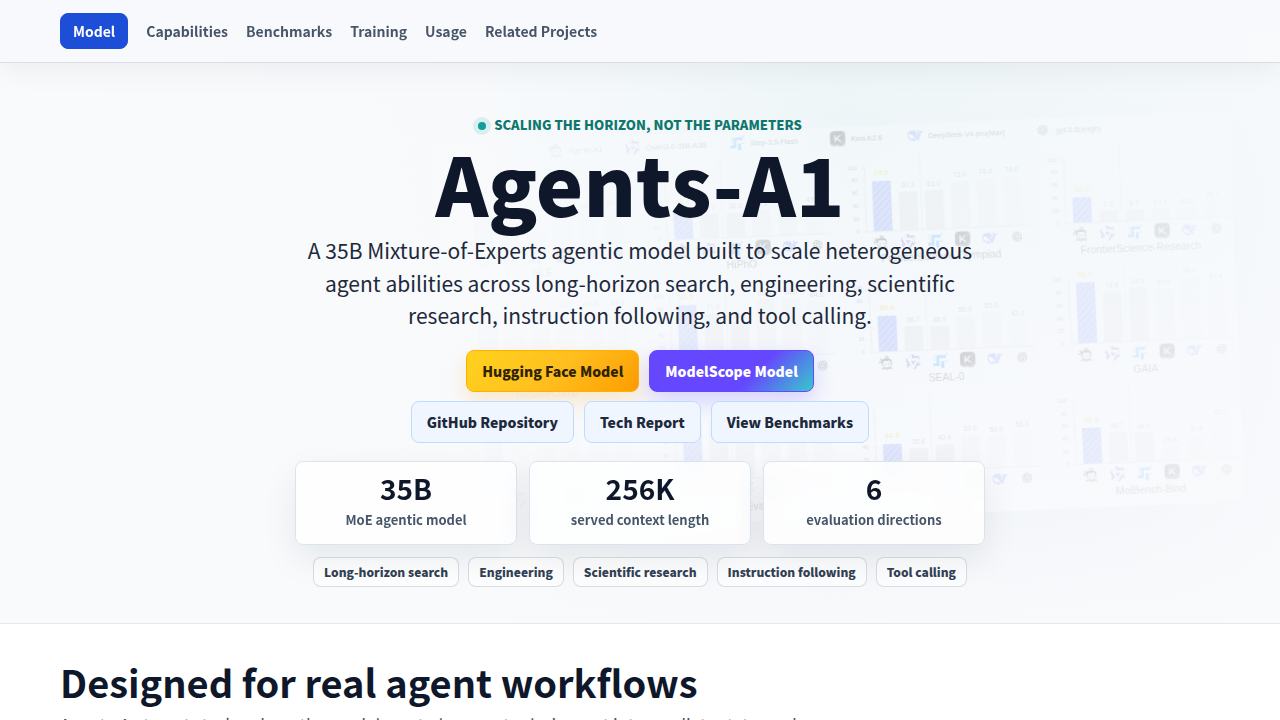
Agents-A1 (35B MoE) Complete Guide 2026: Why a Small-Parameter Model Outperforms Giants in Agent Tasks