Summary
Numbat brings visibility to the "invisible operations" of the exploding number of AI agents — one of the most important security OSS projects of 2026.
Perplexity Numbat Complete Guide 2026: The Open-Source Security Layer That Visualizes & Blocks AI Agent Actions
"Leaving AI agents to run unsupervised and uneasy that you have no idea what they're doing on their own?"
"Are you leaving AI agents unsupervised, with no idea what they're doing on their own?"
On July 29, 2026, Perplexity open-sourced Numbatunder Apache 2.0. It's a security layer thatmakes AI agent activity visible and blocks dangerous operations before execution.
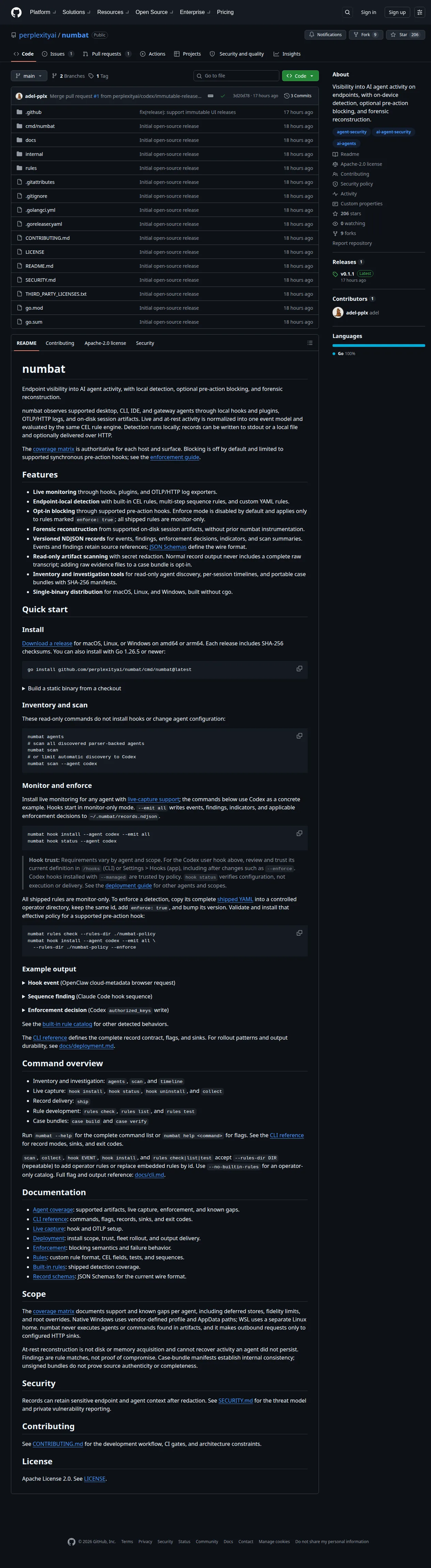
↑ Screenshot (scroll to view full): Numbat GitHub
Based on Perplexity's official announcement and the GitHub repository (perplexityai/numbat) README, this article explains who Numbat is, what it can do, and how to get started — in a beginner-friendly way.
After reading this article you'll know:
- What problems Numbat solves with "monitoring, detecting, and blocking AI agents"
- Which agents it supports (Codex, Claude Code, OpenClaw, etc.) and what dangerous behaviors it detects
- How to go from installing a single Go binary to monitoring
- The "detection flywheel" of alert → block → analyze
- Why security teams should evaluate it now
What Is Numbat? (3 Lines)
Numbat is a security layer that monitors, detects, and blocks AI agent activity.
- See everything agents did (live & retroactively)
- Block dangerous operations before execution (rule-based)
- Runs instantly as a single Go binary (macOS/Linux/Windows)
Perplexity open-sourced what it actually uses internally, under the Apache 2.0 license.
Why It's Needed (Background)
In 2026, AI agents that directly access terminals and file systems — Claude Code, Codex CLI, OpenCode, and others — are exploding in popularity.
The problem: these agents can:
- Read SSH keys
- Delete files
- Extract API keys from environment variables
- Fetch cloud metadata
Almost no mechanism existed to even "know" what they did.
Numbat fills this "agent visibility gap."
What It Can Do (Feature List)
All features from the GitHub README:
| Feature | Description |
|---|---|
| Multi-agent support | Codex CLI, Claude Code, OpenClaw, OpenCode, and other terminal agents |
| Live & post-hoc visibility | See agent actions in real time and review the full history afterward |
| Pre-execution blocking | Enforce rules that stop dangerous operations before they run |
| Local detection | All analysis happens locally; no external data transmission |
| Rule engine (CEL) | Flexible YAML rules using CEL expressions |
| Single binary | One Go binary for macOS / Linux / Windows |
| Apache 2.0 | Completely free, commercial use OK |
Supported Agents & Detectable Dangerous Behaviors
Supported Agents
- Codex CLI (OpenAI)
- Claude Code (Anthropic)
- OpenClaw
- OpenCode
- And other terminal/file-system agents
Dangerous Behaviors It Detects
| Behavior | Risk |
|---|---|
| Reading SSH private keys | Credential theft / lateral movement |
| Deleting files | Data loss |
| Extracting API keys from env vars | Credential exposure |
| Fetching cloud metadata | Cloud account compromise |
| Writing to sensitive paths | System tampering |
| Executing arbitrary commands | RCE / supply chain risk |
How to Get Started
1. Install (Single Go Binary)
go install github.com/perplexityai/numbat/cmd/numbat@latest
2. Start Monitoring
numbat --config numbat.yaml
3. Write Rules (YAML + CEL)
rules:
  - name: "Block SSH key reads"
    description: "Prevent agents from reading SSH private keys"
    match: |
      action == "read" && path.matches(".*\.ssh/.*id_rsa.*")
    action: block
Alert → Block → Analyze (Detection Flywheel)
Questions Readers Ask
Q1. Which agents are supported?
Codex CLI, Claude Code, OpenClaw, OpenCode, and other terminal/file-system agents.
Q2. What's the detection mechanism?
Hook-based, lightweight. With blocking enabled, pre-action hook latency is added.
Q3. Does it send data externally?
No. All detection is local — no external transmission.
Q4. Can I create my own rules?
Yes. Freely create rules with CEL-based YAML.
Q5. Where do alerts go?
Choose from stdout, local files, or HTTP delivery.
Q6. What is "Computer"?
Perplexity's internal analysis system. All features work with Numbat standalone.
Q7. Can I try it right now?
go install github.com/perplexityai/numbat/cmd/numbat@latest and run.
Summary — Numbat Is a "Security Essential for the Agent Era"
Bottom line: Numbat brings visibility to the "invisible operations" of the exploding number of AI agents — one of the most important security OSS projects of 2026.
- Multi-agent support (Codex, Claude Code, OpenClaw, etc.)
- Local detection (no external transmission)
- Pre-execution blocking (enforce rules)
- Single Go binary (instant deployment)
- Apache 2.0 (completely free)
Conversely, these people don't need to rush:
- You don't use AI agents internally yet
- Agent permissions are minimal and risk is low
Numbat is Perplexity's "battle-tested in production" tool open-sourced as-is. In the era where agents write code, touch files, and access the cloud — it's becoming an essential layer for monitoring those "invisible operations."
"From today, your AI agents are under surveillance."
Numbat visualizes agent behavior and stops danger before execution. That's the new security standard of 2026.
Information in this article as of July 30, 2026. Based on Perplexity official X (@perplexity_ai) and the GitHub perplexityai/numbat README.
Related reading
Share this article
Related articles

Jun 22, 2026
Hermes Agent Complete Guide 2026: The Most Powerful Open-Source AI Agent by Nous Research
Aug 12, 2026
Learn Harness Engineering Complete Guide 2026: The Free Course That Makes AI Agents Reliable with a "Harness"

Jun 22, 2026
Hermes Agent vs Cursor — Full Comparison 2026: Which Should You Choose? Complete Guide to Using Both
Aug 9, 2026
Herdr Complete Guide 2026: The New Standard Runtime Where Any Agents Can Talk to Each Other
Aug 9, 2026
Learn Claude Code Complete Guide 2026: The Free Learning Site That Builds Your Own AI Agent from Scratch in 20 Sessions
Aug 25, 2026
AgentSky Guide 2026: Run Claude Code, Codex & Hermes in the Cloud with One API (The OpenRouter for Agents)