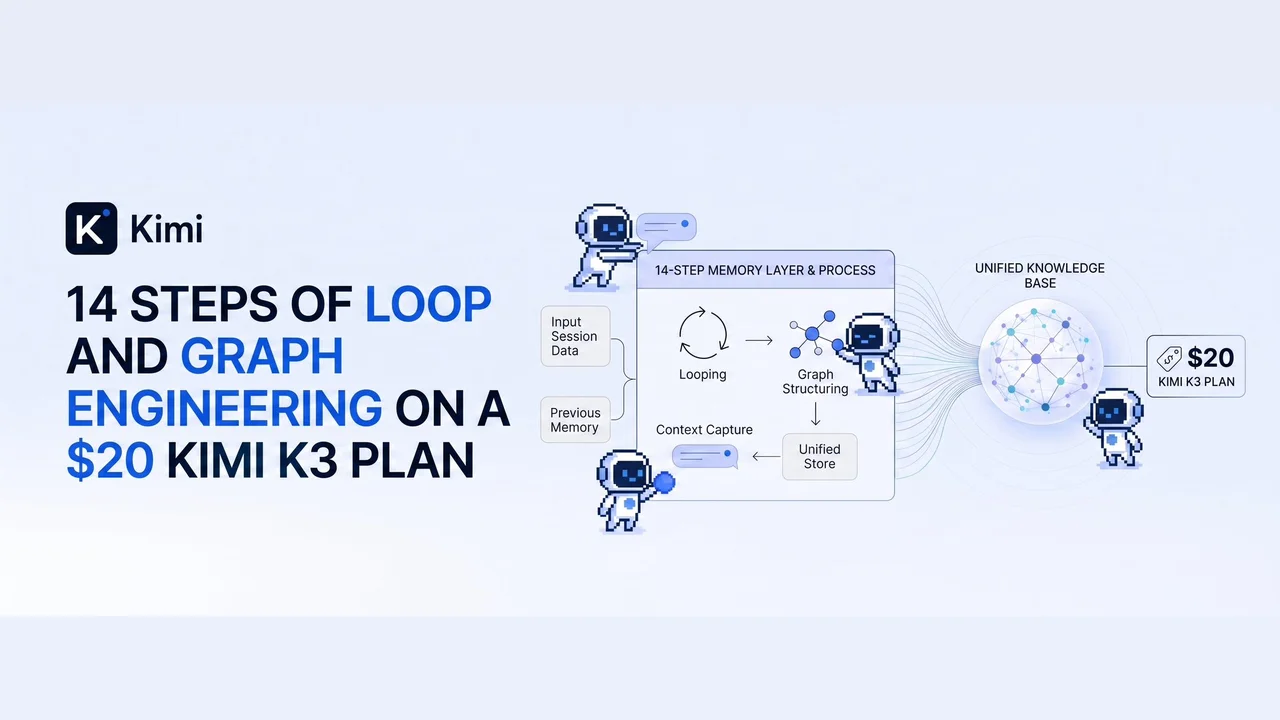
Summary
You built a multi-agent setup. It worked for a week. Then the same mistakes came back — duplicate entities, weak sources accepted, instructions re-executed. So you rebuilt it. Again.
300 AI Agents, One Graph, and a Loop That Edits Itself (2026): The 14-Step Blueprint Explained
You built a multi-agent setup. It worked for a week. Then the same mistakes came back — duplicate entities, weak sources accepted, instructions re-executed. So you rebuilt it. Again.
Mr. Buzzoni (@polydao) lived that loop four times this year and threw three setups away. His viral X article — "300 Agents, One Graph, and a Loop That Edits the Loop" — distills those failures into a 14-step blueprint for running 300 parallel AI agents on a $20 Kimi K3 plan as a system that gets better every run. This guide unpacks it.
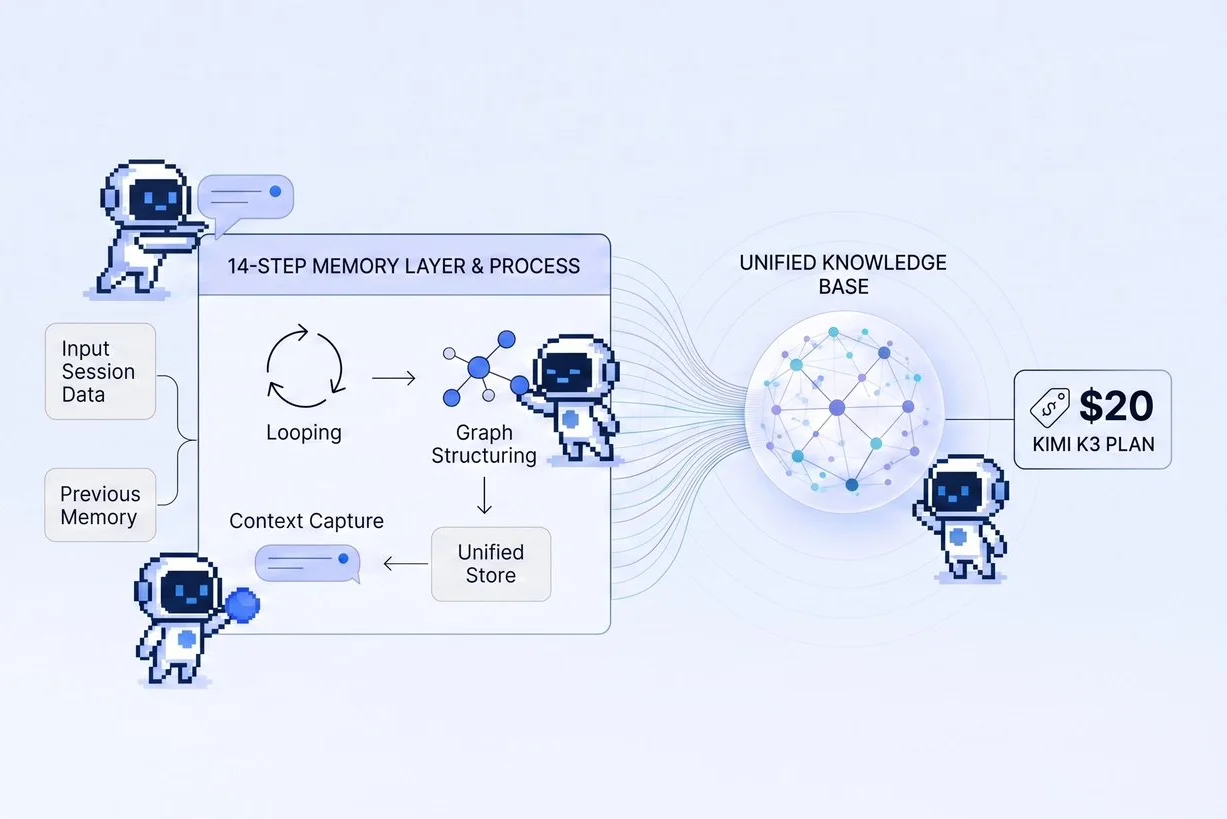
Image credit: cover art from @polydao's X article (September 5, 2026, by the author).
Why a Swarm Alone Fails
Parallel agents buy you capacity, not correctness. Without shared memory and permanent constraints, 300 agents duplicate each other's mistakes 300 times. The article's thesis: a swarm gives scale, but the loop + graph + constraints turn it into an asset that improves between runs.
The build order is everything. Build it backwards and it collapses within a week — the author's own experience, four times over.

Phase 1: Build a Loop That Finishes (Steps 1–4)
Pick tasks that are frequent × reversible — competitive tracking, lead enrichment, source triage. Nothing that sends money or publishes early.
- Write the stop condition first (2) — "process 10 items then stop," "3 consecutive runs with zero new findings." Countable criteria, never "until thorough." This is your runaway-prevention
- Move instructions into SKILL.md (3) — versioned, with self-check sections. This is how 300 agents produce consistent output formats
- Add an external gate (4) — the agent never approves its own work. Cheap script checks run before expensive model verification
Phase 2: The Graph = Queryable Memory (5–8)
This phase is what stops the same error from recurring across runs.
- Define nodes in SCHEMA.md (5) — "primary entity = company; everything else is an attribute." Decided once, applied forever
- Build aliases.csv before the first run (6) — "Block," "Block Inc," and "Block Ltd" resolve to one entity. Skip this and your data fragments, poisoning every later query
- Fix the return schema (7) — merges become deterministic code, not prose judgment calls. This is why the system scales to 300 agents cheaply
- All nodes first, then edges — and every edge carries a source line (8) — weeks later you can still answer "why does it say that?"
Phase 3: Dynamic Workflows (9–11)
Now the static script becomes adaptive:
- The launch block is a query against the graph (9) — not a hardcoded list. Next week's run naturally dispatches different agents because the structure changed
- Route by node state (10) — skip settled nodes, spend only where value remains. Run 2 costs a fraction of run 1 — this is where the economics flip
- Branch on verdicts (11) — pass the exact rejection reason back to the retrying agent, cap the retries
Phase 4: Routines and the Meta-Loop (12–14)
The system starts editing itself:
- Scheduling + event triggers (12) — match cadence to data velocity. Daily runs on monthly data is money burned
- Every correction goes into CONSTRAINTS.md, permanently (13) — loaded at the start of every run. A few lines grow into dozens. This accumulation is the magic that stops repetition
- The meta-loop (14) — weekly, read the run history and propose edits to your own SKILL.md / SCHEMA.md / CONSTRAINTS.md. Keep human approval as the final gate — an agent that unilaterally edits its own constraints will eventually remove the inconvenient ones
The File Structure: Just 5 Files
| File | Role | Updated |
|---|---|---|
| SKILL.md | Agent instructions, versioned, with self-checks | meta-loop proposes |
| SCHEMA.md | Node/edge definitions; makes merges deterministic | rarely |
| aliases.csv | Entity alias table, built before run 1 | as discovered |
| CONSTRAINTS.md | Permanent record of every correction; loaded each run | on every fix |
| run logs | Append-only history with evidence lines | every run |
One directory per author, numeric prefixes to enforce write order (launches before returns, graph after nodes) — so the system can't be corrupted by out-of-order writes.
Caveats
- Source lines ≠ truth — evidence on an edge can still point at a weak source. Verify critical claims yourself
- Don't skip meta-loop approvals — the safety comes precisely from a human keeping the final gate
- The economics start at run 2 — skip the setup work (schema, aliases, constraints) and you get none of the compounding
- Check rate limits and ToS — 300 parallel agents hitting any service deserves a compliance look first
Who Should Build This
Good fit: anyone with weekly/daily research-collection-organize loops; teams whose agent stacks keep resetting; solo operators who want agent output to accumulate as an asset.
Poor fit: one-off tasks (the loop never spins); anyone unwilling to do weekly approvals (Phase 4 stalls without them).
Summary
- A multi-agent system becomes an asset through four layers: a loop that finishes, structured memory, permanent constraints, and a meta-loop that edits the loop
- Three anti-collapse habits: write stop conditions first, build the alias table first, keep source lines on every claim
- Dynamic routing is what makes run 12 cheaper and smarter than run 1
- Humans keep the final approval gate — that's what makes self-improvement safe
Original article: "300 Agents, One Graph, and a Loop That Edits the Loop" by @polydao
Based on Mr. Buzzoni's (@polydao) X article (as of September 2026). Cover image copyright belongs to the original author.
Related reading
- Fable Loop Library Complete Guide 2026: Fully Automating Claude Fable 5 with 25 Workflows, Explained for Beginners
- 【2026】Automating Japanese Startup Lead Research with Codex CLI & Hermes Agent: The Complete Beginner Guide
- OpenConnector Guide 2026: The Open-Source Auth Gateway Connecting 1,000+ SaaS Providers to AI Agents
Share this article
Related articles
Oct 2, 2026
OpenAI dots Explained (2026): GPT-6 Astra Agents That Keep Working, Pricing, Safety Limits, and the Self-Hosted Alternative (OpenDots)
Sep 18, 2026
Jev Ultrafast: How a Browser Agent Finishes a Flight Search in 7.1 Seconds (2026 Guide)

Jun 22, 2026
Loop Engineering 2026: What Is It? Explained Simply for Beginners
Sep 5, 2026
NVIDIA PAIR in 2026: Turn Every PC at Home Into One Local AI Cluster (Free, Setup Guide)
Sep 9, 2026
Mobile MCP: Let AI Agents Control Real iPhones and Android Devices (2026 Guide)
Aug 20, 2026
Berd Complete Guide 2026: Block's Open-Sourced #1 Internal Tool for Building Your "Dream Team" of AI Agents