Summary
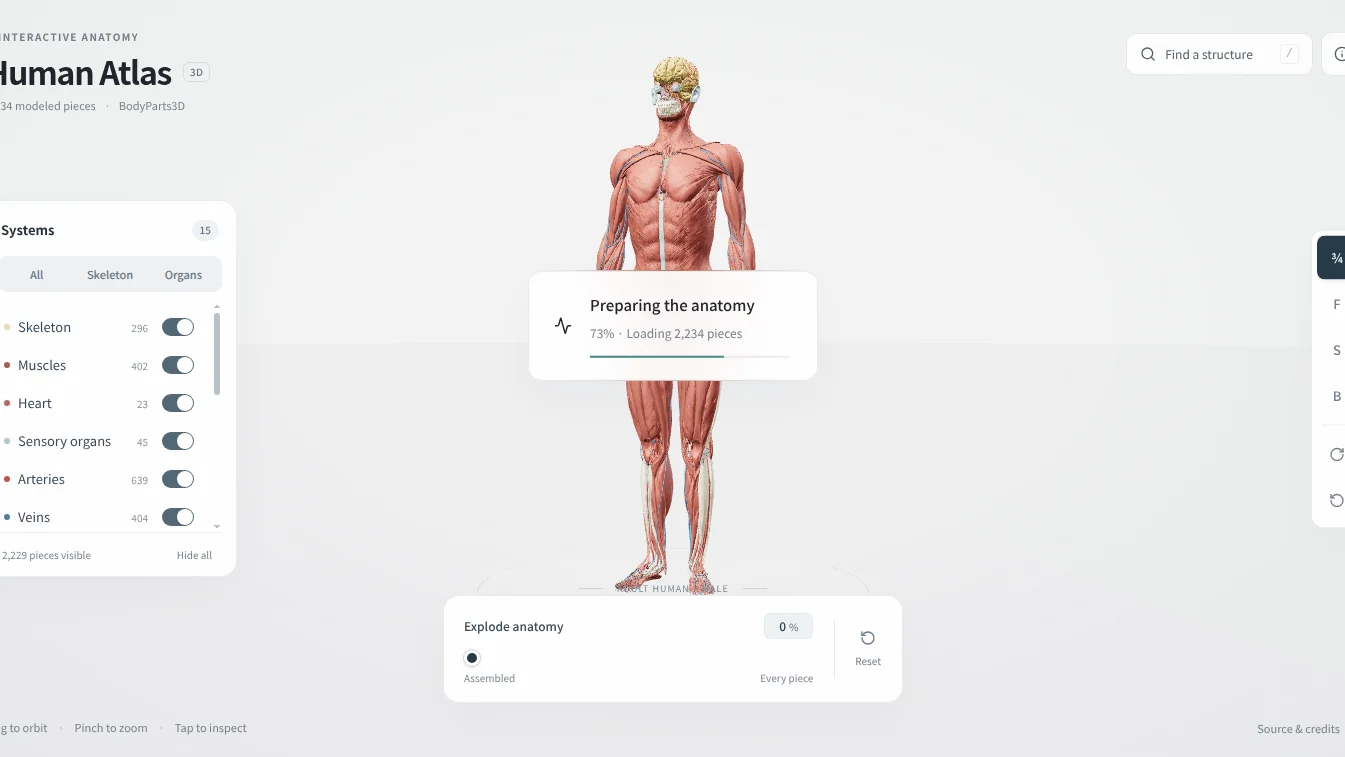
Human Atlas is an open-source educational tool that lets you freely explore a 3D human anatomy model in your browser. Built with React, Three.js, and shadcn/ui, it makes a medical-grade 3D model (BodyParts3D 4.0) accessible to anyone for free.
Human Atlas Complete Guide (2026): Free Open-Source 3D Anatomy Explorer in Your Browser
"Wouldn't it be great to rotate, zoom, and take apart the human body in 3D, right in a browser?"
Human Atlas (287 GitHub stars, MIT license) — released September 2026 — makes that possible. It takes the adult male reference anatomy BodyParts3D 4.0 apart into 2,234 individually selectable 3D meshes, lets you toggle 15 anatomical systems as layers, and search 3,432 named concepts.
In this guide:
- What Human Atlas can do
- System-by-system breakdown (with real numbers)
- How to use it (3D controls, search, exploded view)
- How it works under the hood
- Running it locally
- License and cautions
Live demo: human-atlas-seven.vercel.app Repository: ashemag/human-atlas
What is Human Atlas?
Bottom line: Human Atlas is an open-source educational tool that lets you freely explore a 3D human anatomy model in your browser. Built with React, Three.js, and shadcn/ui, it makes a medical-grade 3D model (BodyParts3D 4.0) accessible to anyone for free.
- 2,234 selectable 3D meshes (click bones, muscles, organs, vessels individually)
- 15 anatomical systems toggleable as layers (skeleton, muscles, heart, nerves...)
- 3,432 searchable anatomy names (English names and source IDs)
- Exploded views that separate every visible piece from the assembled body
- Open source (MIT), free, no API keys required
- Data from BodyParts3D 4.0 (CC BY 4.0, adult male reference)
What you can do: break the body into systems
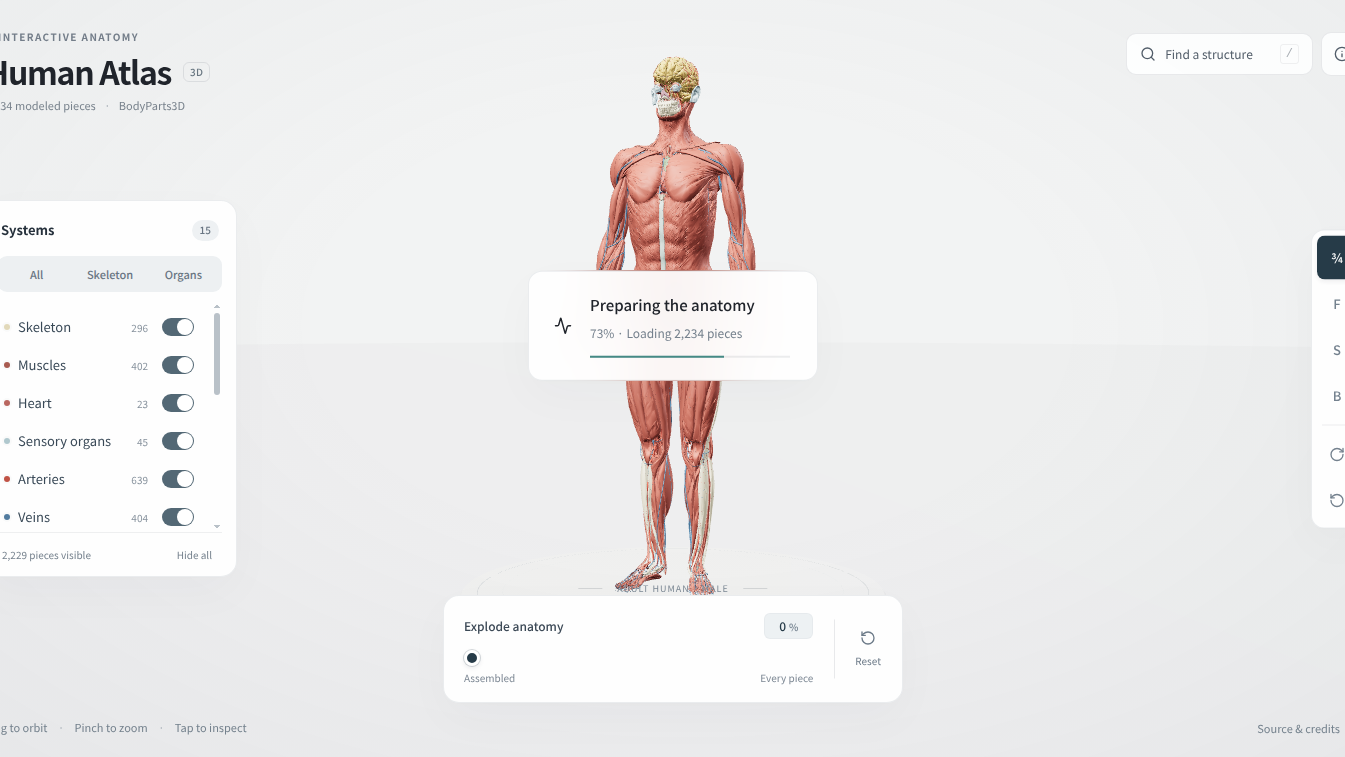
Human Atlas's biggest appeal is layering the body by "system". View only muscles, or trace only blood vessels.
15 systems and part counts (measured)
| System | Parts | Contents |
|---|---|---|
| Skeleton | 296 | All bones and cartilage |
| Muscles | 402 | Skeletal muscles, muscle groups |
| Arteries | 639 | Full arterial network |
| Veins | 404 | Full venous network |
| Nervous system | 139 | Brain, spinal cord, peripheral nerves |
| Respiratory | 119 | Lungs, trachea, bronchi |
| Digestive | 97 | Stomach, intestines, liver... |
| Sensory organs | 45 | Eyes, ears, nose... |
| Heart | 23 | Heart structures |
| Urinary | 6 | Kidneys, bladder... |
| Endocrine | 4 | Hormone-secreting organs |
| Lymphatic | 3 | Lymph nodes... |
| Reproductive | 12 | Reproductive organs |
| Body surface | 5 | Skin surface segments |
| Connective tissue | 40 | Fascia, ligaments... |
※ 2,229 visible parts total (of 2,234 meshes). Figures measured September 2026.
How to use it: 5 basic operations
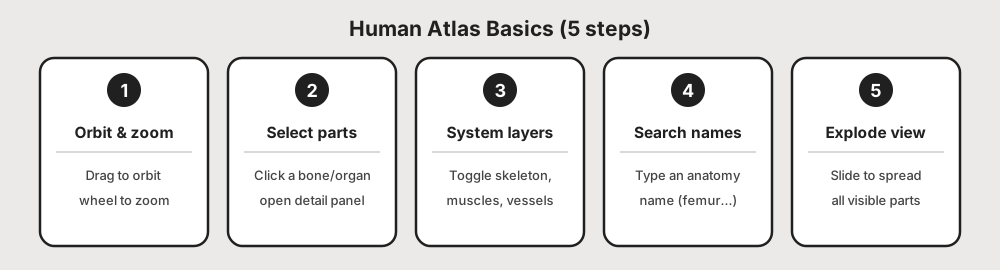
1. Orbit and zoom the 3D view
Drag to orbit (rotate), pinch/wheel to zoom. Observe the body from any angle.
2. Click to select a structure
Click a bone or organ directly on the body. It highlights and its details appear in a panel.
3. Toggle systems
Use the "Systems" panel to turn skeleton, muscles, vessels, etc. on/off individually. Presets like "Skeleton" and "Organs" show the whole body in one click.
4. Search for a structure
Type an anatomy name in the "Find a structure" field (e.g., femur, heart, liver). Pick a suggestion and jump straight to it.
5. Explode the view
Move the "Explode anatomy" slider from assembled anatomy to a spaced-out inventory of every visible piece. Great for understanding each part's shape and position.
Cautions (please read)
Human Atlas is an educational explorer, not a diagnostic or surgical tool (stated in the README).
- Based on an adult male reference model; it does not represent every human structure, variation, or sex difference
- Do not use it for medical diagnosis or treatment decisions
- Geometry is simplified for browser performance (within a 0.2% relative error limit)
- Model data is CC BY 4.0 (attribution required); app code is MIT
It's ideal for education, learning, and presentations — treat it as a visual teaching aid for understanding human anatomy.
How it works: why the browser stays fast
Human Atlas uses several techniques to render the 3D model efficiently.
- Geometry batching: draws thousands of meshes in batches instead of one draw call each
- GPU texture control: translation, visibility, and selection are controlled per-structure via GPU textures (low CPU load)
- Optimized exploded layouts: only visible pieces are packed
- 2,288,268 triangles total, about 33 MB of compressed geometry (first load takes a moment)
Tech stack
- React + TypeScript (Vite)
- Three.js (3D rendering)
- shadcn/ui (UI components)
- WebMCP (optional: exposes anatomy search to compatible browsers)
Run it locally
Requires Node.js 22.13 or newer. No API keys or accounts needed.
# Clone the repository
git clone https://github.com/ashemag/human-atlas.git
cd human-atlas

# Install dependencies
npm ci

# Start the dev server (http://localhost:3016)
npm run dev

# Build the static site
npm run build  # output in dist/
To deploy on Vercel, import the repository and build it as a Vite project (vercel.json is included).
Summary
Human Atlas is the definitive open-source 3D anatomy tool released in 2026.
- Freely explore a 2,234-part human body in your browser
- Toggle 15 anatomical systems on and off as layers
- Search 3,432 anatomy names, select parts for details
- Use exploded views to intuitively grasp structural relationships
- MIT license, free, no API keys — anyone can use it
Your first step: open the live demo (human-atlas-seven.vercel.app) and spin the body around. Show only the skeleton, add muscles, overlay the vessels… simply by exploring, your understanding of human anatomy deepens fast. If you're in healthcare, study, education, or 3D modeling, give it a try.
Share this article
Related articles
Aug 6, 2026
Cloudflare OS Complete Guide 2026: The Open-Source AI Operating System for Your Company, Explained for Beginners
Jul 21, 2026
Buzz Complete Guide 2026: Jack Dorsey (Block)'s Open-Source Workspace Where Humans and AI Agents Work in the Same Room
Aug 9, 2026
Cloudflare Kitesurf Complete Guide 2026: The Agent-First Browser That Uses Up to 7x Less Memory Than Chromium
Aug 25, 2026
OpenCut Guide 2026: The Free Open-Source CapCut Alternative for Web, Desktop & Mobile

Jun 26, 2026
Ornith-1.0 Complete Guide 2026: The MIT-Licensed Open-Source AI Coding Model That Surpasses Claude Opus
Jul 21, 2026
WorldMonitor Complete Guide 2026: The Strongest Open-Source Geopolitical AI for Real-Time Global Awareness in One Dashboard