Summary
AI conversations have never felt this natural — and a demo from Andi Marafioti, research lead at HuggingFace, is going viral. Talk to a robot, and the AI answers faster than a human can think of a reply. And it's built entirely on an open-source stack.
Cerebras × Gemma 4: The Fastest Voice AI Stack Complete Guide 2026 — Parakeet, Gemma 4, and Qwen3TTS
"Ever talked to an AI and wished it could answer as fast as a real person, without the awkward lag?"
AI conversations have never felt this natural — and a demo from Andi Marafioti, research lead at HuggingFace, is going viral. Talk to a robot, and the AI answers faster than a human can think of a reply. And it's built entirely on an open-source stack.
In this article, we break down everything inside that "fastest voice AI stack": the technologies used, how to reproduce it yourself, and the specs required — all in beginner-friendly language.
What You'll Learn
- Details on the 3 OSS models used in the demo (Parakeet, Gemma 4, Qwen3TTS)
- Why Cerebras's ultra-fast inference can hit 1,800 tokens/s
- How to start with HuggingFace Inference Providers from $2
- The Reachy Mini robot's specs and price
- Step-by-step setup to build the same stack yourself
- Required specs for running locally
"So Fast They Added a Delay" — What the Viral Demo Means
Andi Marafioti (ex-Unity), who leads multimodal research at HuggingFace, published this demo on July 1, 2026. The concept is simple:
Talk to a Reachy Mini robot — it looks around with its camera, searches the web, and replies by voice.
That alone might sound like "okay, sure." But the response speed was on another level.
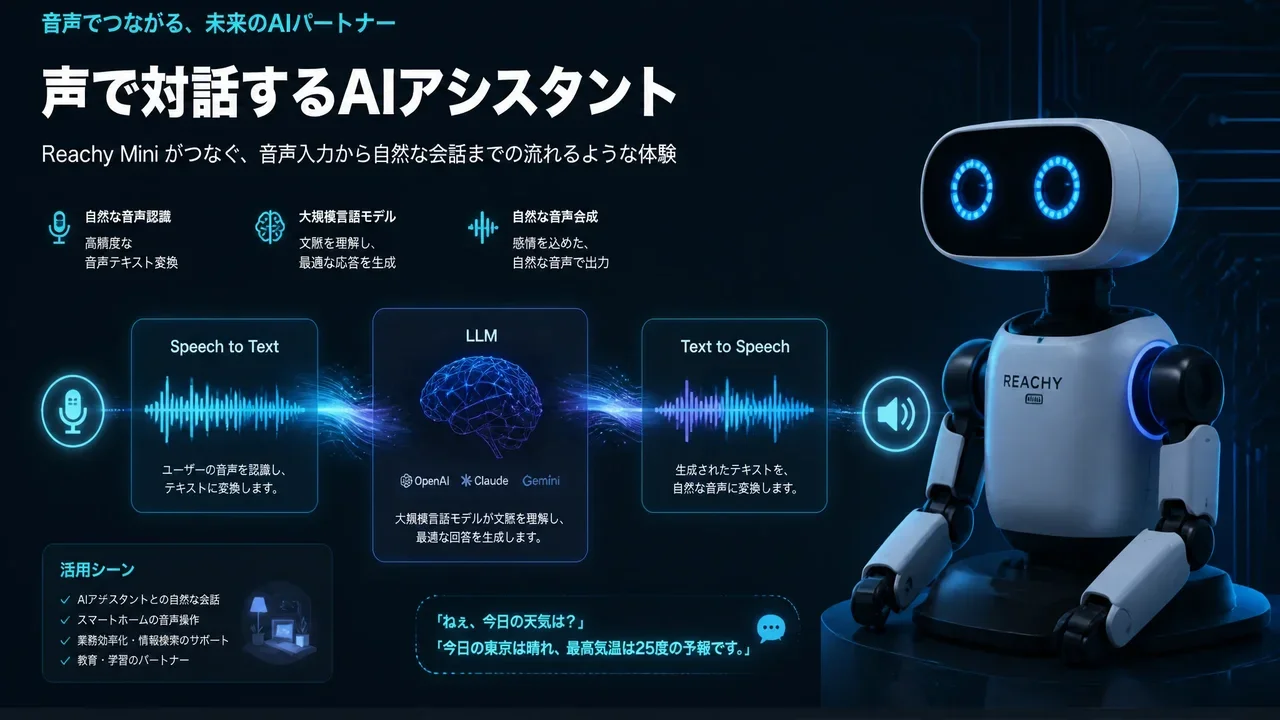
- Speech recognition (STT): NVIDIA Parakeet → ~80ms
- Language understanding + image recognition + web search (LLM): Gemma 4 31B on Cerebras → ~300ms latency, 1,800 tokens/s
- Speech synthesis (TTS): Qwen3TTS GGML-optimized → ~120ms TTFA (Time To First Audio)
Total: under 500ms. Faster than a human going "um…"
In fact, the dev team said they "added a deliberate 1,200ms delay because the response was too fast and felt unnatural." A complete reversal — intentionally slowing down the AI to make it feel more human.
| Component | Model | Latency | Feature |
|---|---|---|---|
| Speech recognition | NVIDIA Parakeet (RNNT-1.1B) | ~80ms | FastConformer + RNNT, 1.1B parameters |
| LLM (language + vision + search) | Google Gemma 4 31B | ~300ms / 1,800 tok/s | Multimodal, Cerebras Inference |
| Speech synthesis | Qwen3TTS (GGML-optimized) | ~120ms TTFA | GGML quantized, runs even on CPU |
| Robot | Reachy Mini ($299+) | - | 4 microphones, 5W speaker, wide-angle camera |
① Speech Recognition: NVIDIA Parakeet (~80ms)
The first stage of the demo is speech recognition — converting the user's voice to text. The model used here is NVIDIA's Parakeet-RNNT-1.1B.
What Is Parakeet?
A state-of-the-art ASR (Automatic Speech Recognition) model from NVIDIA's NeMo team. It combines a FastConformer encoder with an RNNT (Recurrent Neural Network Transducer) decoder — an ~1.1B parameter XXL-size model.
Why Does It Run in 80ms?
Parakeet's strengths:
- FastConformer architecture: 2.7× faster inference than standard Conformer
- RNNT decoder: more accurate than CTC (Connectionist Temporal Classification) and streamable
- NVIDIA NIM optimization: optimized inference on GPU microservices
- 90,000+ hours of training data: multilingual support possible
Main Variants
| Model | Params | Decoder | Feature |
|---|---|---|---|
| parakeet-rnnt-1.1b | 1.1B | RNNT | Most accurate English speech recognition |
| parakeet-ctc-0.6b | 0.6B | CTC | Lightweight and fast, edge-oriented |
| parakeet-tdt-0.6b-v2 | 0.6B | TDT | New Token & Duration Transducer method |
| parakeet-1.1b-rnnt-multilingual | 1.1B | RNNT | Multilingual version |
How to Get It on HuggingFace
Parakeet models are available on NVIDIA's HuggingFace page. You can also access them via the HuggingFace Inference Providers API.
import torch
from transformers import AutoModelForCTC, AutoProcessor

model_id = "nvidia/parakeet-rnnt-1.1b"
processor = AutoProcessor.from_pretrained(model_id)
model = AutoModelForCTC.from_pretrained(model_id)

# Load an audio file and run inference
# ※ Local execution requires a GPU (4GB+ VRAM recommended)
Local Execution Requirements
- GPU: NVIDIA GPU with 4GB+ VRAM (RTX 3060 or higher recommended)
- Memory: 8GB+ RAM
- Storage: ~2.5GB model files
- Framework: PyTorch + transformers or NeMo
- Alternative: parakeet.cpp runs on CPU (slightly lower accuracy)
② LLM: Gemma 4 31B on Cerebras (~300ms / 1,800 tok/s)
This is the core of the stack. Google DeepMind's latest open model, "Gemma 4 31B," runs at ultra-high speed on Cerebras's Wafer-Scale engine.
Gemma 4 31B Specs
The Gemma 4 family is Google DeepMind's latest open model line released in 2026. At 31B parameters, it's also a multimodal model that accepts image input.
- Parameters: 31B (possibly MoE architecture)
- Tasks: text generation, image recognition, code generation, reasoning
- Context length: 32K+ standard
- License: Gemma license (commercial use allowed)
- Features: structured thinking (Chain-of-Thought), Function Calling, dynamic visual resolution
What Makes Cerebras So Fast?
The reason Cerebras inference is abnormally fast is a fundamental architectural difference.
Traditional GPU inference:
- Loads the model into GPU memory (HBM)
- Optimizes with batch processing
- Latency of hundreds of ms to seconds is normal
- Exceeding 1,000 tok/s is rare
Cerebras Inference:
- Wafer-Scale Engine (WSE-3): AI cores arranged on a single giant silicon wafer
- Massive memory bandwidth: no HBM bottleneck
- 1,851 tokens/s recorded (per Artificial Analysis)
- That's ~15× Claude Haiku and ~35× typical GPU endpoints
| Metric | Cerebras Inference | GPU (typical) | Difference |
|---|---|---|---|
| Inference speed | 1,800 tok/s | 50–150 tok/s | 12–36× |
| Time to First Token | ~300ms | 500ms–2s | 2–6× |
| Multimodal | Image + text simultaneously | Similar | - |
| Pricing (Free Tier) | Free (includes $2 credit) | Usage-based only | - |
Using It via HuggingFace Inference Providers
Key point Andi Marafioti revealed: "I use Cerebras through HuggingFace Inference Providers — the free account includes $2 in credits."
That means you can try Cerebras's ultra-fast inference without a credit card.
import os
from openai import OpenAI

client = OpenAI(
    base_url="https://router.huggingface.co/v1",
    api_key=os.environ["HF_TOKEN"],  # HuggingFace access token
)

# Text inference
completion = client.chat.completions.create(
    model="google/gemma-4-31B-it:cerebras",
    messages=[
        {"role": "user", "content": "What is the capital of France?"}
    ],
)
print(completion.choices[0].message.content)

# Image + text inference
completion = client.chat.completions.create(
    model="google/gemma-4-31B-it:cerebras",
    messages=[
        {
            "role": "user",
            "content": [
                {"type": "text", "text": "Describe this image in one sentence."},
                {
                    "type": "image_url",
                    "image_url": {
                        "url": "https://example.com/photo.jpg"
                    }
                }
            ]
        }
    ],
)
print(completion.choices[0].message.content)
Setup is only 3 steps:
- Create a HuggingFace account (huggingface.co)
- Settings → Access Tokens → issue a token
- Set
base_urltohttps://router.huggingface.co/v1in the code above
Model name format: {huggingface_model_path}:{provider_name}
google/gemma-4-31B-it:cerebras
      ↑model ID          ↑provider
Cerebras Pricing
Cerebras's Inference API has the following tiers:
- Free Tier: free. Access to all models. Discord community support
- Developer Tier: $10/month (exact pricing at Cerebras Pricing)
- Enterprise: custom (Dedicated Endpoints)
Via HuggingFace Inference Providers, you can start with the $2 credit included in a free HF account.
③ Speech Synthesis: Qwen3TTS GGML-Optimized (~120ms TTFA)
Qwen3-TTS, developed by Alibaba's Qwen team, optimized for GGML (C++ / llama.cpp family).
What Is Qwen3TTS?
Qwen3-TTS is Alibaba's open-source text-to-speech model. Its features:
- 12Hz tokenizer: far higher-quality voice expression than traditional TTS
- Zero-shot voice cloning: clone a voice from a 3-second sample
- 10+ languages: English, Chinese, Japanese, Korean, French, German, and more
- Emotion control: control tone and emotion of speech
Why GGML?
Running Qwen3TTS in PyTorch requires a GPU, but converting it to GGML lets it run on CPU. The demo achieves 120ms TTFA (Time To First Audio).
Available GGML models:
| Model | Size | Feature | HuggingFace |
|---|---|---|---|
| Qwen3-TTS-12Hz-0.6B-Base (Q8_0 GGUF) | ~600MB | Lightweight, zero-shot voice cloning | badlogicgames/qwen3-tts-0.6b-q8_0-gguf |
| Qwen3-TTS-12Hz-1.7B-CustomVoice GGUF | ~1.5GB | Fixed-speaker, higher quality | cstr/qwen3-tts-1.7b-customvoice-GGUF |
| Qwen3-TTS-12Hz-0.6B-CustomVoice GGUF | ~600MB | Fixed-speaker lightweight | cstr/qwen3-tts-0.6b-customvoice-GGUF |
| Qwen3-TTS-12Hz-1.7B-Base GGUF | ~1.5GB | Full-featured, voice cloning | cstr/qwen3-tts-1.7b-base-GGUF |
Local Execution Requirements
- CPU: AVX2 support (Intel 8th gen / AMD Ryzen or later)
- Memory: 2–4GB (depending on model size)
- Storage: 600MB–1.5GB GGUF files
- Framework: GGML-based tools (llama.cpp derivatives)
- Optional: GPU (MPS/CUDA) for further speedup
④ Robot: Reachy Mini ($299+)
The robot in the demo is the Reachy Mini, developed by Pollen Robotics (Bordeaux, France) in collaboration with HuggingFace.
Specs
| Item | Reachy Mini Lite ($299) | Reachy Mini ($449) |
|---|---|---|
| Price | $299 + shipping | $449 + shipping |
| Onboard computer | External PC (Mac/Linux) | Raspberry Pi 4 included |
| WiFi | None | Yes |
| Power | Wired | Wired + battery |
| Microphones | 4 | 4 |
| Speaker | 5W | 5W |
| Camera | Wide-angle | Wide-angle |
| Accelerometer | None | Yes |
| Neck DOF | 6 DOF | 6 DOF |
| Full-body rotation | Yes | Yes |
| Antennas (animation) | 2 | 2 |
| Size | 28cm H × 16cm W | Same |
| Weight | 1.5kg | Same |
Software
- OS: Raspberry Pi OS or external PC (Mac/Linux)
- Language: Python (JavaScript / Scratch support planned)
- Open source: fully OSS, customizable
- AI integration: build AI apps fully using camera, microphone, and speaker
How It Worked in the Demo
- User speaks to the Reachy Mini
- 4 microphones capture the audio (noise-canceling)
- Wide-angle camera recognizes the surroundings
- Parakeet converts speech → text (80ms)
- Gemma 4 31B processes text + image via Cerebras (300ms)
- Serper web search when needed
- Qwen3TTS synthesizes the reply text → audio (120ms)
- Adds a 1,200ms delay for natural pacing
⑤ How to Build the Same Stack Yourself
The amazing part: everything is reproducible with open source + APIs.
Easiest Setup (API-first)
Even without a Reachy Mini, you can have the same experience on a Mac/Windows/Linux PC alone.
Step 1: Create a HuggingFace account
Create an account at hub.huggingface.co. Free $2 credit included.
Step 2: Issue an access token
Settings → Access Tokens → New Token (Inference Providers permission)
Step 3: Try Gemma 4 on Cerebras
# Set the token in an environment variable
export HF_TOKEN="<YOUR_HF_TOKEN>"

# Test directly with curl
curl https://router.huggingface.co/v1/chat/completions \
  -H "Authorization: Bearer <YOUR_HF_TOKEN>" \
  -H "Content-Type: application/json" \
  -d '{
    "model": "google/gemma-4-31B-it:cerebras",
    "messages": [{"role": "user", "content": "Write a haiku about AI."}]
  }'
Step 4: Try Parakeet (STT)
Use the HuggingFace Inference API:
import requests

API_URL = "https://api-inference.huggingface.co/models/nvidia/parakeet-rnnt-1.1b"
headers = {"Authorization": f"Bearer {os.environ['HF_TOKEN']}"}

with open("audio.wav", "rb") as f:
    data = f.read()
response = requests.post(API_URL, headers=headers, data=data)
print(response.json())
Step 5: Try Qwen3TTS (TTS)
Download a GGUF model and run locally:
# Download the model
pip install huggingface-hub
huggingface-cli download badlogicgames/qwen3-tts-0.6b-q8_0-gguf \
  qwen3-tts-0.6b-q8_0.gguf --local-dir ./models

# Run with llama.cpp's TTS-enabled build (support coming soon)
# Or use a GGML-based TTS tool like CrispASR
Full Setup Requirements
| Component | Method | Minimum Spec | Cost |
|---|---|---|---|
| STT (Parakeet) | API (HuggingFace Inference) | Internet connection only | Within free tier |
| STT (Parakeet) | Local (parakeet.cpp) | CPU AVX2 / GPU 4GB VRAM | Free |
| LLM (Gemma 4 31B) | API (Cerebras via HF) | Internet connection only | Free – $2 credit |
| LLM (Gemma 4 31B) | Local | Not practical (31B params) | Not possible even on RTX 4090 24GB |
| TTS (Qwen3TTS) | Local (GGML) | CPU AVX2 / RAM 4GB | Free |
| TTS (Qwen3TTS) | API | Internet connection only | Check pricing |
| Robot | Reachy Mini | Raspberry Pi 4 or external PC | $299–$449 |
| Robot | Alternative (webcam + PC) | Mac/Windows/Linux | Free (if you have a PC) |
Important: Local Limitations
Running Gemma 4 31B locally is not practical.It won't even fit on a standard GPU (RTX 4090 24GB VRAM). This is whereCerebras's API shines — through HuggingFace Inference Providers, you can try ultra-fast inference with a $2 credit.
If you insist on local, consider lighter models instead (smaller Gemma 4 variants, Llama 3.2, etc.).
Why This Stack Is Getting Attention
1. Fully open source
Parakeet, Gemma 4, Qwen3TTS, Reachy Mini — all open source. Compatible with OpenAI's Realtime API (drop-in replacement). No vendor lock-in.
2. Speed defies common sense
"Too fast, so we added a delay" says it all. Traditional voice AI takes 2–5 seconds total across recognize → think → respond. This stack does it in 500ms.
3. Proven on a 10,000-unit fleet
Not a single demo unit — it already runs on a fleet of 10,000 Reachy Mini robots. Proof that HuggingFace's research team operates it at production level.
4. Start from $2
Create a HuggingFace account and get $2 in free credits. That alone lets you try Gemma 4 on Cerebras. Starting with zero risk is huge.
Summary: The Future This Stack Opens Up
This demo isn't just about a "fast AI robot." It signals a paradigm shift:
- This much is possible with APIs alone: a local PC + HuggingFace API exceeds last year's production quality
- The power of open source: fully OSS, yet a drop-in replacement for OpenAI's Realtime API
- The real arrival of Wafer-Scale: Cerebras's 1,800 tok/s overturns GPU conventional wisdom
Andi Marafioti said a full blog post is coming soon. This stack will only grow from here.
3 steps if you want to try it now:
- Create a HuggingFace account ($2 credit included)
- Test Gemma 4 on Cerebras with the Python code above
- If interested, order a Reachy Mini ($299+)
※ This article does not contain affiliate links. It's for informational purposes. Prices and specs are as of July 2026.
Recommended Reading
Share this article
Related articles
Jul 30, 2026
Hermes Agent Voice Mode Complete Guide 2026: Hands-Free CLI, Telegram Voice Replies, and Discord Voice Chat
Sep 4, 2026
Voz Guide 2026: On-device Speech to Text on the Apple Neural Engine — Transcribe 10 Minutes in 2 Seconds (4.7x Faster than Whisper, Swift SDK Setup)

Jun 26, 2026
Qwen-AgentWorld Complete Guide 2026: The Revolutionary Approach That Makes AI Predict Environments Instead of Actions
Aug 12, 2026
Grok 4.6 Complete Guide 2026: The Latest Frontier-Intelligence Model at the Same Price, Compared with Official Benchmarks
Sep 21, 2026
Qwen-Image-2.1 Complete Guide (2026): The First Major Open Model That Generates True Transparent PNGs (RGBA) in ComfyUI
Jul 18, 2026
【2026】Qwen3.6-35B Genesis Hermes GGUF Complete Guide: Running an Uncensored Multimodal MoE on Your Local PC