Summary
The short answer: Muse is Meta's first personal AI agent that actually does the work — sending emails, booking travel, and completing purchases with your approval. Free tier gives you 100 million tokens per week.
Meta Muse: The Personal AI Agent That Emails, Books, and Shops For You (2026)
"What exactly does Meta's Muse do — and can it really shop for me?"
The short answer: Muse is Meta's first personal AI agent that actually does the work — sending emails, booking travel, and completing purchases with your approval. Free tier gives you 100 million tokens per week.
This article breaks down every scene of the official 82-second promo video plus Meta's official announcement and coverage from TechCrunch and Reuters.
What This Article Covers
- What Meta's Muse actually does (with scene-by-scene breakdown of the promo video)
- Pricing: free tier, Power $20, Maximum $100 — and why a card is required
- The "Secure VM + Sentinel" security architecture
- The VM's actual specs (measured)
- Availability (US only, for now)
- Realistic risks you should know before signing up
What Is Muse?
Muse is a personal AI agent launched by Meta on September 8, 2026. Unlike chatbots that answer questions, Muse acts: it opens a browser, fills out forms, and completes transactions on your behalf.
Powered by Meta's in-house Muse Spark model, it works across email, travel, shopping, and calendar apps. When you close the app, Muse keeps working in the background and checks back when something needs approval.
The Promo Video, Scene by Scene
The official 82-second launch video shows four key scenarios:
- Chat handoff: User types "This week has been hectic." — Muse replies "What can I take off your plate?"
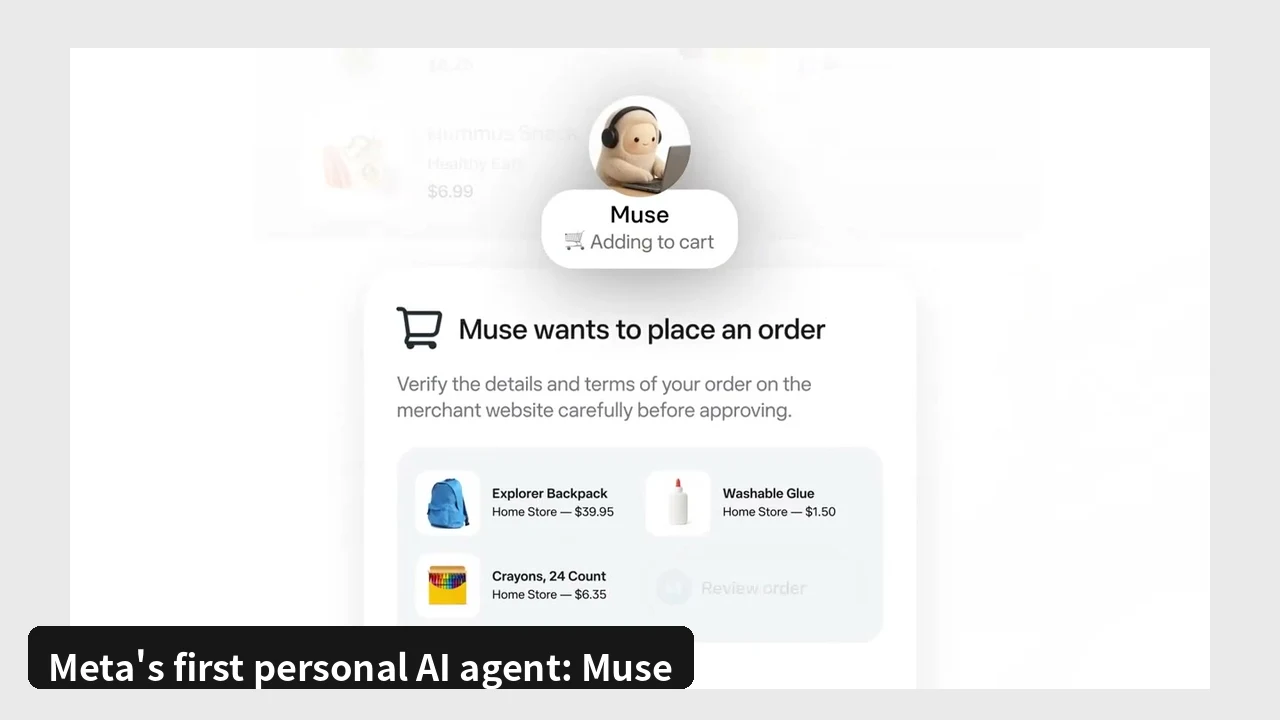
- School supplies: Muse finds a list of items to order from email, adds them to cart ("Adding to cart" status), and asks approval before checkout
- Approval card: "Muse wants to place an order" shows the full cart (Explorer Backpack $39.95, Washable Glue $1.50, Crayons $6.35) with an explicit warning to verify details on the merchant site
- Proactive flight alert: "Your flight is delayed 2hrs due to storms in Denver..." — Muse checks alternate routes before you even ask
Taglines shown: "AI that is always working for you", "AI that tracks your goals for you", "AI that keeps you in control", and "Connect your apps".
Pricing
| Plan | Monthly | Notes |
|---|---|---|
| Free | $0 | Up to 100M tokens per week (per Zuckerberg), with usage meter |
| Power | $20 | More agent cycles |
| Maximum | $100 | Maximum capacity |
A payment card is required at signup, even for the free tier. Meta says most users will stay on the free plan.
Security Architecture: Secure VM + Sentinel
- Muse Secure VM: a dedicated virtual machine per user, hosting the agent and credentials, isolated from other tenants
Measured runtime environment
We asked Muse itself to report its runtime, and these are the measured values (as of September 2026).
| Item | Measured value |
|---|---|
| Form | Linux VM dedicated to one user (persistent between conversations) |
| OS | Ubuntu 24.04.5 LTS (Noble Numbat), kernel 7.0.0-38-generic |
| CPU | 2 vCPU (AMD EPYC 9D25, x86_64) |
| Memory | 7.7GB, no swap (5.5GB in use at the time of measurement) |
| Disk | 100GB home (btrfs, mostly free) + 7.5GB system |
| GPU | None (CPU only) |
| Uptime | About 1 hour 13 minutes, load average 0.12 |
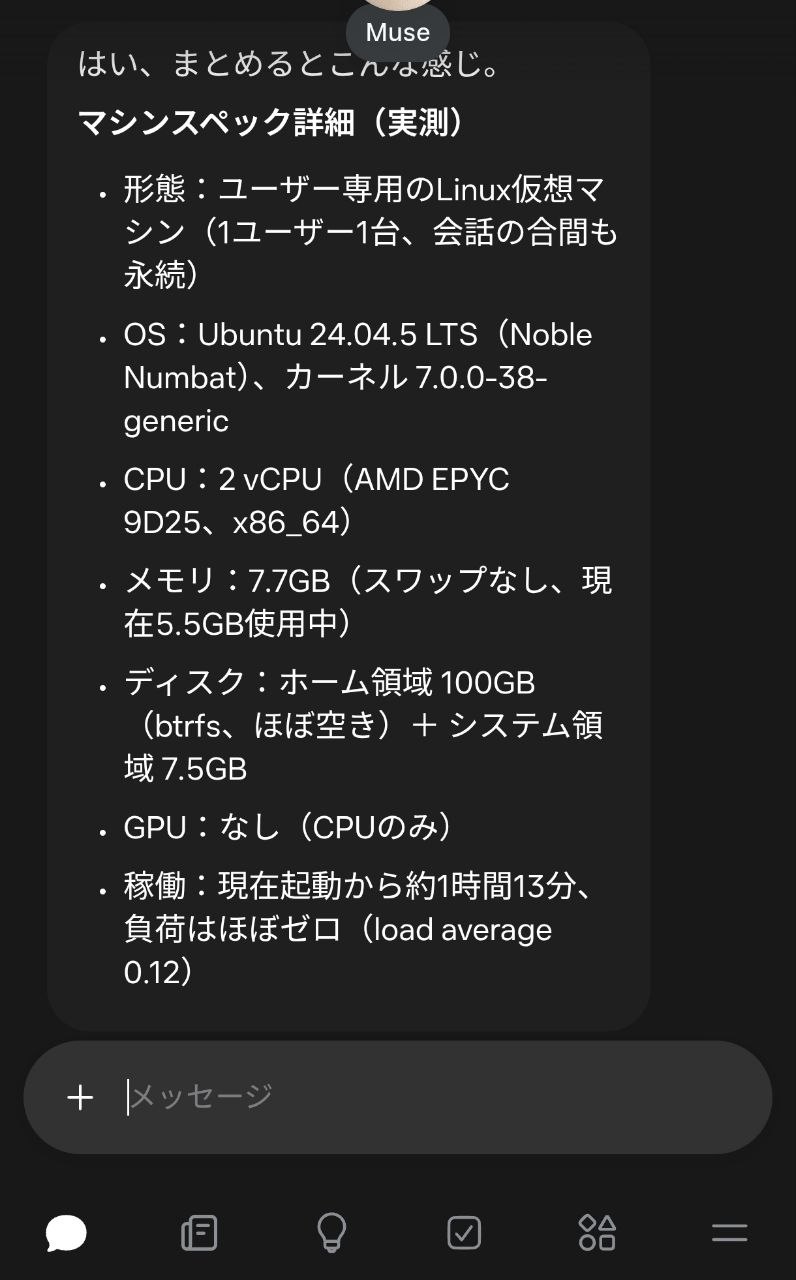
Image: the operator's screenshot of Muse reporting its runtime (September 2026, Japanese UI).
What the numbers tell you is that this VM is not the model's brain but its hands. 2 vCPU and 7.7GB of RAM is close to the smallest VPS tier, and there is no GPU. Inference happens outside the VM, while the VM handles the light work: driving a browser, organising files, waiting for approvals. With no swap configured, heavy multi-tab sessions could push it into memory pressure.
- Sentinel: a separate agent that inspects everything Muse sends to the internet; approval prompts bypass the AI model entirely (protection against prompt injection)
- Payments: Stripe Link single-use card numbers, with Shop Pay and 1Password coming
- Muse never sees your passwords or payment methods directly
- Full audit trail of every action
Availability: US Only (For Now)
Muse launched in the US on iOS, Android, muse.ai, and WhatsApp. Meta AI glasses support is coming later. India, Japan, and Europe are not in the initial rollout, and Meta hasn't announced dates.
How It Compares
| Agent | Price | Key trait |
|---|---|---|
| Muse (Meta) | Free + $20/$100 | Consumer-ready, WhatsApp/Instagram integration, Secure VM |
| OpenClaw | OSS + API costs | Self-hosted, any model, 240k+ GitHub stars |
| Claude Managed Agents | API pricing | Zero-infra production agents on Claude |
| OpenAI Agents SDK | API pricing | Multi-agent pipelines with typed handoffs |
Muse's bet is distribution: 3 billion+ users across Meta's apps. Whether consumers trust Meta with this much access — two weeks after an $18B multistate settlement — is the real question TechCrunch raises.
Pros and Cons
Pros
- Extremely generous free tier (100M tokens/week)
- Human-in-the-loop approval for purchases and emails
- Stripe Link single-use cards protect real payment info
- Bug bounty up to $300,000
- No ads
Cons and Risks
- US-only at launch (Japan: not available)
- Card required at signup
- Meta's track record: the Muse Image tool was pulled in July after an opt-out privacy backlash; an $18B settlement landed two weeks before launch
- Agents "will sometimes make mistakes", per Meta itself
Questions Readers Ask
Is Muse available in Japan?
Not yet. US-only at launch (iOS, Android, muse.ai, WhatsApp). No announced date for Japan.
Can Muse buy things without my approval?
No. Purchases and emails require an explicit approval dialog, and checkout runs through Stripe Link single-use card numbers.
What's the free tier limit?
100 million tokens per week, according to Zuckerberg's Threads post. A usage meter shows what's left and warns before hitting the cap.
Is this the same Muse as the image generator?
No. Muse Image (July 2026) is the image-generation model. This Muse is the personal AI agent. Both run on the Muse Spark model family.
Verdict
Muse is the first mass-market consumer AI agent from a major platform — and its free tier (100M tokens/week) is almost absurdly generous. If it reaches Japan, it could become the default way ordinary people hand off digital errands. Until then, US users get first crack at the most ambitious consumer agent yet, and the rest of us can watch how the Sentinel security model holds up in practice.
For related reading, see our complete guide to Meta Muse Image and the Mobile MCP smartphone-agent guide.
Invite code (for readers in the US)
Give the personal AI agent "Muse" a try. If you use my code in [Settings] within 48 hours of joining, we both receive 1 billion Muse tokens.
Code: D3384N
Join from muse.ai/joinAs noted above, Muse is US-only as of September 2026, and using a VPN risks violating its terms, so we do not recommend it. This is for readers who are in the US or travelling there. The redemption field only appears for 48 hours after signing up (mobile: Settings > Redeem token; web: muse.ai Settings > General > Usage > Invite code).
Sources: Meta official announcement "Introducing Muse" · @Muse on X (Sep 8, 2026) · TechCrunch · Reuters · Gizmodo hands-on.
Share this article
Related articles

Jul 10, 2026
Meta Muse Complete Guide 2026: Agentic Image Generation and the Privacy Debate
Sep 26, 2026
MuseAI-Skills Explained (2026): Reading Meta Muse's 68 Skills and Runtime Snapshot
Aug 10, 2026
Meta Muse Glimmer Complete Guide 2026: The 30B Open-Weight Model That Changes Local AI Agents
Aug 6, 2026
Muse Code Complete Guide 2026: Meta's Terminal Coding Agent & Muse Spark 1.2 Explained
Aug 9, 2026
Hermes HUD Mode Complete Guide 2026: The Overlay AI Agent That Sees, Understands, and Controls Your Screen
Sep 7, 2026
Meta 'Muse Spark 1.3 max' Is Now Public: Ties Claude Opus 5 on the Coding Agent Index (September 2026)