Summary
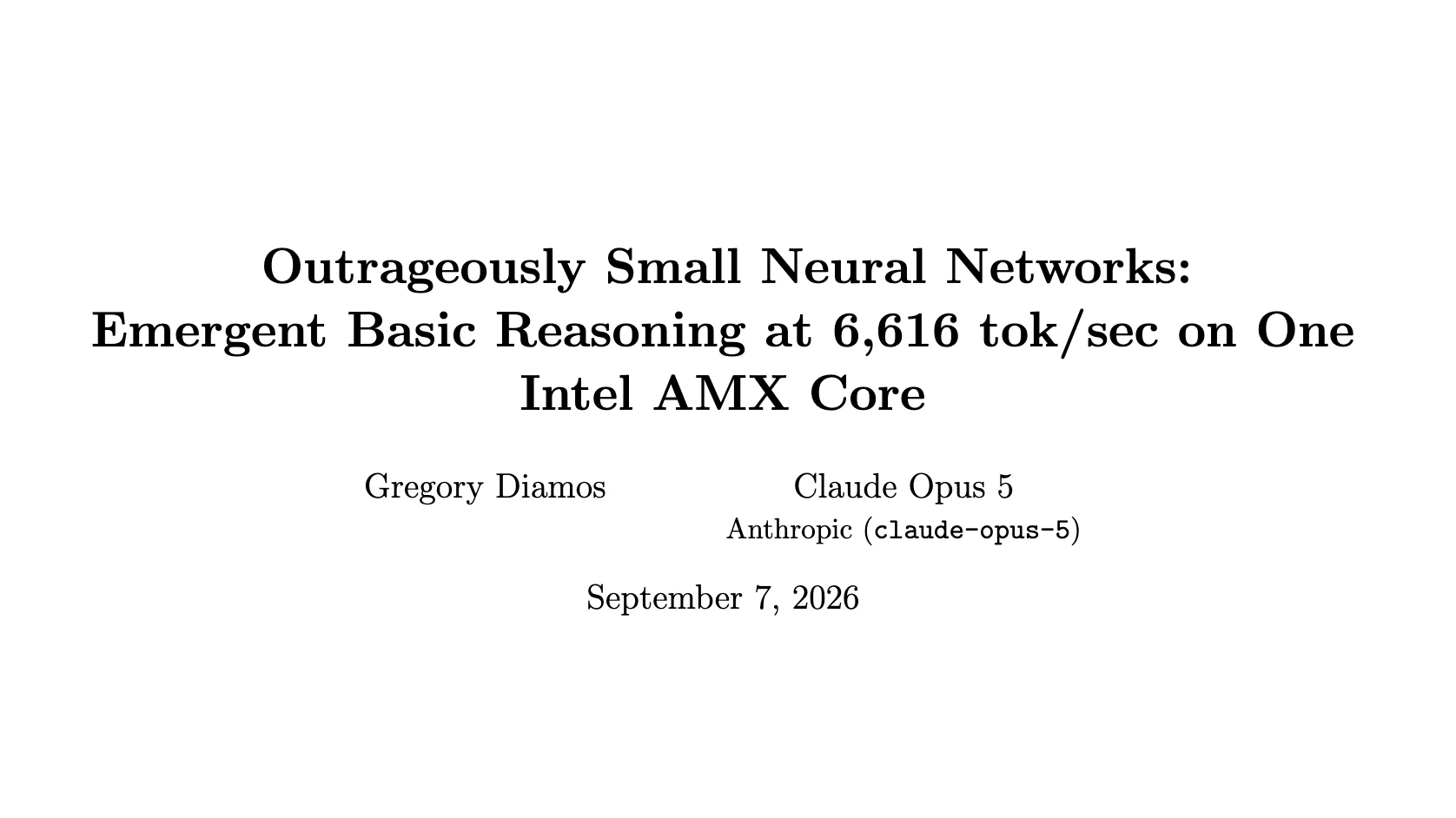
On September 7, 2026, Greg Diamos — MLPerf founding member, formerly Baidu SVAIL, now at Anthropic — published a paper that takes the opposite constraint to its limit: training a 3.65M-parameter language model on exactly one CPU core. In nine hours, basic reasoning behaviors emerged. The experiments were run by Claude Code, and the paper lists "Claude Opus 5" as co-author — by name, not as an acknowledgment.
A Tiny LLM Learned to Reason on One CPU Core in 9 Hours (2026 Guide)
"You need racks of GPUs to train anything useful" — still true? Maybe not for much longer.
On September 7, 2026, Greg Diamos — MLPerf founding member, formerly Baidu SVAIL, now at Anthropic — published a paper that takes the opposite constraint to its limit: training a 3.65M-parameter language model on exactly one CPU core. In nine hours, basic reasoning behaviors emerged. The experiments were run by Claude Code, and the paper lists "Claude Opus 5" as co-author — by name, not as an acknowledgment.
The tweet went viral (2,517 likes / 2,602 bookmarks in ~10 hours). Here's the full breakdown.
What you'll learn
- Why single-core? (roofline-first architecture design)
- What emerged after 9 hours (actual numbers)
- The paper's core: 4 failures invisible in the loss curve
- What this means for local AI
The Experiment at a Glance

- Hardware: one physical core of an Intel Xeon Silver 4514Y (Emerald Rapids), pinned with OMP_NUM_THREADS=1
- Model: block-routed MoE with 3.65M active parameters (E=128 experts)
- Training: 259M tokens in ~9 hours at 6,616 tok/s
The point is not "a small model runs on CPU." It's that the architecture is derived from a single-core roofline: weights sized to fit the 2MiB L2, matrix ops big enough to amortize the 1.4–1.5µs GEMM dispatch floor. Training throughput is an end-to-end forward+backward rate, not a micro-benchmark.
What Emerged After 9 Hours
| Task | Accuracy | Chance |
|---|---|---|
| In-context induction | 93% | 7% |
| Positional shift | 90% | 7% |
| Two-digit addition | 47% | 23% |
These were behaviors the team assumed needed a much larger budget. They appeared at 5% of the tokens of the longest run.
And the 4.91B-token run shows training loss still descending at the end — 1,481 tokens per active parameter, roughly 74× the Chinchilla ratio, with no floor in sight. At normal scales that ratio is unaffordable; at 3M parameters it's cheap. That's the inference-optimal regime.
Post-Training: 4 Rounds to a Working QA Model
The pretrained model couldn't generate — it entered an absorbing state within 5 free-running tokens. Four rounds of post-training, each addressing a failure the previous one exposed:
| Round | Effect |
|---|---|
| 1. Instruction SFT | stop-on-EOT 0→52.5% |
| 2. QA SFT | EM 0→13.9% |
| 3. Abstention rebalance | over-refusal 57.7→19.8% |
| 4. Vocabulary fix | EM 15.3→18.2%, F1 19.6→23.2% |
Final: 18.2% EM / 23.2% F1 on held-out extractive QA (25.0% on DROP). Weak in absolute terms; remarkable for the size.
The Core: 4 Failures the Loss Curve Never Reported
- Expert collapse — 128 experts collapsed to one function while loss looked plausible. Caught via the RMSNorm gain participation ratio (1.0/384). Root cause: not enough tokens per expert (the budget law E ≤ Nk/(τPe)).
- Zero-init insertion isn't function-preserving under top-k routing — a zero-gated expert still displaces the k-th ranked one.
- The routing statistic dominates — windowed vs prefix mean was the single largest improvement (4.431→4.041), but their proposed explanation was refuted by their own shuffle ablation. They published the refutation alongside.
- Untrained vocabulary rows win the argmax — tokens with corpus count 0 are never sampled as negatives, keep logit ≈0, while trained-but-wrong tokens get pushed to ≈−7.9. Result: 29% of DROP answers were just ' ballo' or 'Frequently'.
The lesson the authors emphasize: "The score said DROP F1 20.7% — a weak model. The generations said ballo — a bug." Those are different problems. Print the generations next to the score.
Why This Matters: The Data Is Doing the Work
Every corpus in the mixture (Nemotron family) is a large-model artifact — quality classification, rephrasing, generated reasoning traces. Training a tiny model on them is implicit distillation.
When models this small were last studied seriously, such corpora did not exist. Past results about what tiny models can't do were partly measuring a data distribution.
The consequence: hold the model and hardware fixed, and a one-core budget buys more capability each year as curation improves. The cheapest experiment is to re-run the same config on the next corpus release.
Questions Readers Ask
Q: Is 6,616 tok/s fast? Not GPU-fast, but for batch data processing on a core that costs nothing to borrow, it's a meaningful target — the whole point is the roofline of one core.
Q: Is the model usable? It's a research artifact: passage-grounded extraction works, arithmetic doesn't.
Q: Did Claude Code really do it all? Per the author-contribution section: Claude Opus 5 ran experiments, implemented the architecture, diagnosed failures, and drafted the paper; Diamos set direction, made design decisions, and reviewed.
Q: Can I try it? Yes — gdiamos/amx-reasoning-v1-instruct on Hugging Face, Apache-2.0. Note: AutoModelForCausalLM won't work; use the bundled example.py with the vocab mask and greedy decoding.
Summary
- One core, 9 hours, 3.65M parameters → basic reasoning emerges earlier than assumed
- The four failures are the real teaching material — none visible in the loss curve
- Data curation quality is now an axis of progress independent of compute
The paper and code are fully public. Start from example.py.
Source: Gregory Diamos, Claude Opus 5 — Outrageously Small Neural Networks (Sep 7, 2026)
Related
Related reading
Share this article
Related articles
Aug 31, 2026
Quackd Guide 2026: Give Your $399 Microduck Robot an AI Brain (LLM-Driven Robot Control, Simulator Included)

Aug 16, 2026
Cheaper Inference Price Comparison 2026 (as of Aug 16): Up to 60% Off AI Models, Fully Explained
Jul 18, 2026
KTransformers Complete Guide: Run DeepSeek-R1 on 24GB VRAM with This CPU-GPU Collaboration Framework (2026 Guide)

Aug 24, 2026
FreeToken Guide 2026: Run 290B+ Frontier MoE Models on Your Gaming PC — Edge-Native Inference Explained
Jul 28, 2026
Kimi K3 Complete Guide: The 2.8T World's Largest Open Model and the 0.18B Tiny Version That Runs on Potato PCs (2026)

Aug 15, 2026
How DHH Rewrote a Python Library in Rust with Claude in One Shot: The Full 11M-Token Process, Explained (2026 Guide)